


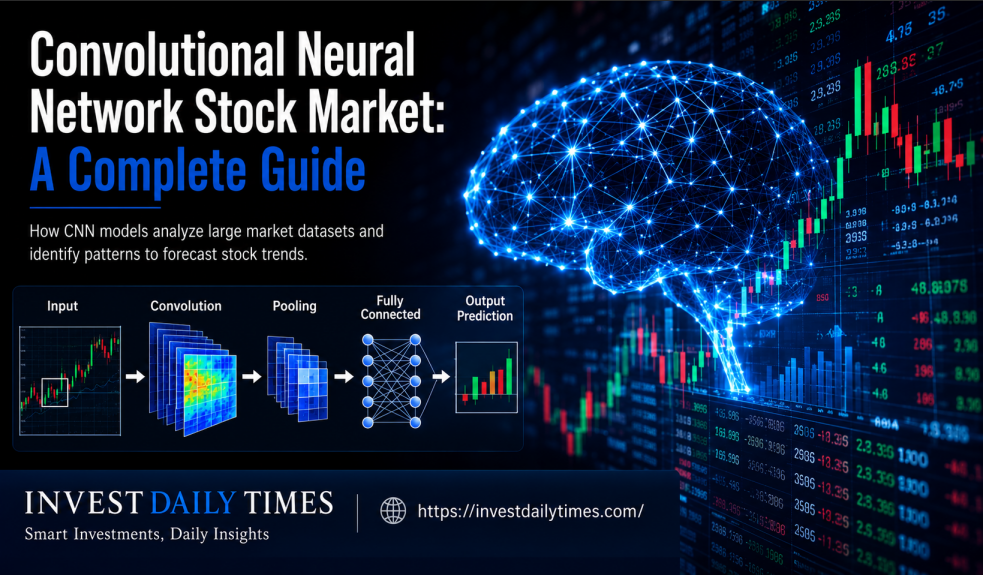
We are discussing today Convolutional Neural Network Stock Market. The artificial intelligence is changing the financial markets where investors and institutions are able to analyze large volumes of market data much faster than their conventional methods of analysis. One of the most powerful deep learning technologies is the Convolutional Neural Network (CNN), a computer vision model which is currently studied extensively in predicting the stock market. CNNs can reveal more relationships than may be apparent in existing statistical models, or manually formulated trading rules, by learning complex patterns directly on historical financial data.
The increasing use of AI in the financial industry has increased interest in CNN-based forecasting. Fortune Business Insights projects that the global AI in banking market will be nearly USD 46.85 billion in 2026 due to the rising expenditure on AI-based analytics, automation, fraud detection, and risk management. Meanwhile, algorithmic trading has continued to grow and there is a need to develop more sophisticated predictive models that can handle high amounts of financial data effectively.
Although CNNs are becoming more popular, they are not programmed to accurately forecast stock prices. Macroeconomic conditions, geopolitical events, company earnings, investor sentiment and unforeseen market shocks that cannot necessarily be discovered through historical data are some of the factors that affect financial markets. This is why CNN models can be considered more as decision-support systems, which support traders and analysts instead of substituting human judgment.
This tutorial describes the functioning of convolutional neural network stock market models, their input and output data types, their benefits and drawbacks, practical use, and best practices in creating workable AI models to predict the stock market.
What Is a Convolutional Neural Network Stock Market Model?
A Convolutional neural Network (CNN) Stock Market model refers to a deep learning framework, which processes previous financial data to recognize trends that could potentially be used to predict future market dynamics. Though CNNs were developed to identify images, scholars have been able to apply it to financial forecasting since they can automatically extract useful features using complex data without necessarily depending on manually selected trading indicators.
Origin of CNN and Yann LeCun
Convolutional Neural Networks Yann LeCun, who developed the LeNet architecture, was the first to show that neural networks could learn visual features automatically given plain data. Such a breakthrough shook up computer vision and then led researchers to adopt CNNs in other fields such as healthcare, manufacturing, cybersecurity, and quantitative finance.
Applications in Stock market prediction CNNs can be applied to different types of financial data, such as OHLC (Open, High, Low, Close) prices, trading volume, technical indicators, volatility information, and charting representations such as candlestick charts. The model does not need to be defined with market rules manually, but learns the historical patterns that are most significant during the training.
Recent studies have extended CNNs to include other architectures, including Long Short-Term Memory (LSTM) networks, Gated Recurrent Units (GRUs), and Transformer models. Within such hybrid systems, CNNs are used to extract informative features in the market, whereas sequence-learning models are used to learn price dependencies over longer time. This is one of the most popular combinations in AI-based financial forecasting.
Despite their potent learning models, CNNs do not have the same comprehension of financial markets that human analysts do. They rely solely on historical data, quality of features and training to make predictions. CNN models need to be validated and retrained continuously to ensure the accurate performance in response to market conditions.
How Convolutional Neural Networks Work in Stock Market Analysis
The CNN-based stock market models are based on a systematic learning procedure which converts past financial data into significant foretelling characteristics. The process usually starts with high-quality market data being collected, and this may be in the form of OHLC prices, trading volume, volatility measures, and technical indicators. This information can be in numerical form or can be translated into image-like feature like candlestick charts or Gramian Angular Fields (GAF), to enable CNNs to identify visual market patterns depending on the research methodology.
The fundamental element of the model is the convolution layer, in which a series of filters are used to scan the input data to detect local patterns that occur repeatedly. These filters are used to identify edges, shapes and textures in computer vision. They get to learn the market structures in the financial analysis such as momentum changes, support and resistance areas, price breakouts, and volatility clusters. As the data propagate further to data layers, CNNs will merge these low-level patterns into higher-level representations of the market that can enhance the effectiveness of the predictions.
Model Training and Validation
Once the feature has been extracted, the model is trained on historical data with known results. In training, optimization algorithms like Adam or Stochastic Gradient Descent (SGD) continuously optimize the parameters of the network to reduce errors in prediction. In order to make sure that the model does a good job on unknown data, researchers test it on separate validation and testing sets instead of using training accuracy as the only metric.
Due to the dynamic nature of financial markets, prior success is not a guarantee of future success. Market behavior can change with time as a result of economic cycles, alterations in policy, earnings announcements and unforeseen international occurrences. This is why professional CNN models need continuous retraining, walk-forward validation and effective risk management before they are taken into consideration in actual trading.
Why CNN Models Are Becoming Important in Financial Markets
The reason as to why CNN Models are emerging to be significant in the financial markets.
Financial industry produces huge volumes of structured and unstructured information on a trading day. Conventional statistical models are typically ineffective when dealing with such complicated data, whereas CNNs have the ability to automatically identify latent relationships among a variety of financial variables. This capability has rendered deep learning an ever more useful instrument of quantitative study, portfolio evaluation, and market prediction.
The fast development of algorithmic trading has also boosted the need for AI-based prediction models, with ongoing financial forecasting research helping improve modern deep learning techniques for market analysis. Research in the industry shows that worldwide market in algorithmic trading is considered to have a value of about USD 20-25 billion in 2026 and this is anticipated to further grow during the decade. The presence of algorithms and high-frequency trading in the major equity markets represents about 60-75 percent of the entire trading volume, which underscores the increasing dependence on automated market analysis and execution systems.
The access to powerful computing resources is another reason why CNN is adopted. Recent GPUs, cloud computing systems and neural network frameworks like TensorFlow and PyTorch have made it much quicker to train advanced neural networks. Together with the availability of large historical financial data, these technologies have enabled CNN-based research to be more realistic to investment firms, researchers, and fintech companies.
Nevertheless, CNNs can be best utilized as a component of a larger trading system as opposed to independent trading systems. Professional organizations integrate AI-generated insights with risk management, macroeconomic analysis, liquidity analysis, and human skills to aid more informed investments.
Types of Data Used for CNN-Based Stock Prediction
Convolutional Neural Network Stock Market model heavily relies on the quality and diversity of the data to be used in training. Because CNNs are trained directly on the data, rather than being guided by a set of rules that may or may not be relevant to the task at hand, it is important to feed them with relevant and well-prepared inputs to produce reliable predictions. To understand the behavior of the market in various dimensions and enhance the strength of the model, researchers tend to integrate various sources of data.
Most CNN prediction models are based on historical market data. This usually consists of Open, High, Low, Close (OHLC) prices, adjusted closing prices, trading volume, daily returns and volatility indicators. These variables enable CNNs to determine repeated price patterns, momentum changes, and short-run trends in the market based on past trading.
Another source of information is technical indicators. Moving Averages (MA), Relative Strength Index (RSI), Moving Average Convergence Divergence (MACD), Bollinger Bands, Average True Range (ATR), and stochastic oscillators are considered common indicators. Rather than considering these indicators separately, CNNs are trained on the interaction of various indicators in distinct market settings to generate significant trading signals.
Image-Based Financial Data
Image based financial representations are one of the special advantages of CNNs. Numerical time-series data are often transformed into candlestick charts, Gramian Angular Fields (GAF), Markov Transition Fields (MTF), recurrence plots and heatmaps as suggested by researchers. Gramian Angular Fields (GAF) maps one-dimensional financial time-series financial data, like historical prices or trading volume, into two-dimensional images without losing temporal relationships. This enables CNNs to find patterns in the market behavior in form of visual patterns and identify spatial features that would not have been so visible in raw numerical data. These visual representations are gaining popularity in the study of financial deep learning as they capitalize on the strengths of CNNs in recognizing visual patterns.
In addition to technical analysis, other sophisticated CNN models use basic financial information like earnings reports, revenue growth, valuation ratios, and balance sheets. Other research models also incorporate macroeconomic indicators, such as inflation, interest rates, GDP growth and unemployment, and sentiment measures derived out of financial news and corporate announcements. A combination of several high-quality data sources tends to improve model performance, though, it is important to remove irrelevant features to reduce overfitting.
Convolutional Neural Network Stock Market Prediction Methods
A number of CNN-based methods have been suggested to forecast stock market movements, and each of the methods is aimed at fulfilling various forecasting tasks. The architecture selected depends on prediction horizon, data available, computing capabilities, and the complexity of the financial problem under solution.
The most popular strategy is to apply one dimensional (1D) CNNs, in which the history prices, trading volume, and technical indicators are left in numerical form. The convolutional filters break down the sequential financial information in order to determine short term trends that occur in the market at relatively low computational prices.
Financial information is also converted to images and then trained using another popular technique. Candlestick charts are one of the most commonly used representations as they show a number of price variables in one visual representation. Another method used by researchers is Gramian Angular Fields (GAF) and Markov Transition Fields (MTF) to convert time-series data into image format and use CNNs to identify recurring market structures based on the image.
CNNpred Framework
One well-known financial prediction framework, CNNPred, was created by Ehsan Hoseinzade and Saman Haratizadeh to integrate multiple financial data sources into a deep learning model. CNNpred, unlike the conventional prediction models, is a composite of a variety of data sources, including technical indicators, commodity and future markets, currency exchange rates, and global market indices. The researchers also proposed a 3D-CNN architecture that was able to learn relations across financial markets in parallel, and which obtained superior predictive power when evaluated in a series of experiments compared to a variety of traditional neural network baselines.
Hybrid models of deep learning have become more popular in current financial studies. In such systems, CNNs initially extract meaningful features on financial information, and then long-term sequential relationship are analyzed using LSTM, GRU, or Transformer models. Many peer-reviewed articles suggest such hybrid architectures tend to provide more reliable forecasting performance compared to standalone CNN models. Nonetheless, performance differs with data quality, market trends, future prediction and evaluation procedures and thus the rigorous validation is significant rather than a single reported accuracy value.
Benefits of Using CNN for Stock Market Forecasting
Automatic feature extraction is one of the best attributes of CNNs. Rather than have analysts choose trading rules or technical indicators manually, CNNs are directly learnt to understand meaningful market patterns using historical data. This allows the model to detect more complicated relationships that might not be detected using traditional statistical methods and minimize human bias when selecting features.
They can also be used to process high-dimensional financial data by CNNs. Contemporary financial markets produce vast volumes of data, such as historical prices, technical signals, volatility metrics, macroeconomic factors, and alternative data. These varied inputs can be effectively processed through CNN architectures, especially with the help of the GPU acceleration and state-of-the-art deep learning systems.
Their flexibility is another great plus. CNNs are capable of processing both numerically-represented time-series and image-based financial representations in the form of candlestick charts, GAF images, and heatmaps. This is flexible and enables researchers to test various data formats and integrate several information sources in a single prediction model.
Scholarly studies also indicate that CNN performance tends to increase when combined with such sequence-learning models as LSTMs or Transformer networks. CNNs are adapted to local market characteristics whereas sequence models are used to capture long-term temporal correlations. Though the hybrid models are said to perform better in forecasting than other studies do, this is only because good data is employed, the validation is realistic and the risk is managed as opposed to one figure of the accuracy of the headlines.
Limitations and Challenges of CNN Models
In spite of its merits, CNNs are not a panacea to predict the stock market. Economic policy, geopolitical events, corporate profits, investor behavior, and unforeseen events in the world economy can all drive the financial markets and cannot necessarily be forecasted by the past. This is why even advanced CNN models cannot always forecast the future movement of the price with full accuracy.
One of the most typical problems is overfitting. A CNN can learn patterns present within the training data rather than learn actual market relationships. Though these models can be very impressive in their historical accuracy, they are often ineffective when subjected to new market conditions. To minimize this risk, proper validation, regularization methods, and walk forward testing are required.
The non-stationary nature of financial markets is another difficulty. The dynamics between variables in the market change over the time, such that a model that is trained in one economic cycle might not work well under the new economic condition. Constant retraining and regular assessment of performance is then required to ensure predictive reliability.
CNN models need also huge amounts of clean and high-quality data and considerable computation resources to train. Moreover, they are commonly black-box models where it is hard to explain the mechanism behind the production of this or that prediction. This is why the majority of professional investors consider CNN forecasts to be a part of a larger investment process and do not rely on them as decision-making systems.
CNN vs LSTM vs Transformer: Which AI Model Performs Better?
There is no one deep learning architecture that has been shown to outperform all in every stock market prediction task. The best model is determined by the available data, the aim of the prediction, the computing resources and the general design of the system.
| Feature | CNN | LSTM | Transformer |
| Primary Strength | Automatic feature extraction | Long-term sequence learning | Attention-based global relationship learning |
| Best Data Type | Price patterns, technical indicators, chart images | Financial time-series | Large and complex financial datasets |
| Training Speed | Fast | Moderate | High computational cost |
| Captures Long-Term Dependencies | Limited | Excellent | Excellent |
| Common Financial Use | Pattern recognition and feature extraction | Time-series forecasting | Advanced forecasting and multimodal AI |
| Modern Usage | Frequently combined with LSTM or Transformer | Often used in hybrid models | Increasingly adopted for large-scale financial prediction |
Instead of adopting one architecture, most current forecasting systems use CNNs with LSTM or Transformer models to take advantage of the assets of both models. As a practical matter, data quality, realistic backtesting, and proper risk management tend to be much more significant factors in predicting performance than the neural network architecture used.
Real-World Applications of Convolutional Neural Network Stock Market Systems
Convolutional Neural Network Stock Market models have a much broader practical use though not limited to scholarly research. Deep learning is increasingly applied by financial institutions, hedge funds, fintech companies, and quantitative research teams, to enhance market analysis, automate trading research, and aid investment decisions. Although CNNs are seldom completely independent trading systems, they are significant in deriving valuable information out of large financial data.
Algorithms trading is one of the most popular applications. CNNs examine the past price trends, technical signs, and volume of transactions to detect the recurring market patterns, which could be used to indicate the possible buying or selling opportunities. These models are more flexible to changing market conditions because they are not based on fixed trading rules but rather learn continuously using past data.
Market trend classification is also considered to be common with CNNs. Instead of forecasting an exact future stock price, most of the models categorize the market as most likely to be bullish, bearish, or range-bound. This data will aid the portfolio manager in modifying the risk exposure, asset distribution, and enhance investment strategies in general.
Big banks are also increasing their artificial intelligence applications. BlackRock is including AI functions to its Aladdin investment platform to enhance portfolio analytics and risk management, whereas JPMorgan Chase has created AI-based trade technologies like LOXM (Liquidity Optimization Execution) to enhance the execution of trade institutions. Even though the exact neural network structures employed by these companies in internal systems are not publicly available, the fact that they make investments in AI proves the increasing significance of deep learning in the contemporary financial markets.
Human oversight, ongoing model validation and robust risk management is still needed to achieve successful deployment despite these developments. Professional organizations consider CNNs to be decision-support tools that do not substitute experienced analysts.
Best Practices of establishing an Accurate CNN Prediction Model.
It takes far beyond choosing a deep learning architecture to develop a reliable Convolutional Neural Network Stock Market model. The quality of the training data, validation process, and evaluation methodology usually affect the performance more than the network.
The initial one is the gathering of historical market information that is clean and trustworthy. Reliable financial data providers should provide OHLC prices, trading volume, adjusted prices and technical indicators. There should be corrections of missing values, duplicate records and inconsistent timestamps prior to the start of model training.
The chronological order of financial data should also be maintained by the researchers. The random shuffling of observations in time-series can result in look-ahead bias, which gives unrealistic results that cannot be realised in real-time trading. In the case of financial time-series, walk-forward validation is often suggested since it tests the model using historical data and tests the model on the following unseen time period, which is close to the conditions of real-world trading. Rolling-window validation is also commonly used by many quantitative researchers and it keeps refreshing the training data and less reliance on the old market regimes. A combination of walk-forward and out-of-sample testing offers a better evaluation of the performance of a CNN model.
Though CNNs do so automatically, inputs that are chosen carefully, including volatility measures, macroeconomic variables and market sentiment may enhance the quality of predictions. Simultaneously, the number of superfluous features should not be too many as it adds complexity and the risk of overfitting.
Lastly, prediction is not the only criterion to evaluate a model. Precision, Recall, F1 Score, Maximum Drawdown, Sharpe Ratio, realistic transaction-cost analysis, and other metrics are more indicative of whether a model would be useful in the real financial markets.
Common Mistakes to Avoid in Convolutional Neural Network Stock Market Projects
Most CNN stock forecasting projects do well in backtests but do poorly in live trading due to methodological errors that can be avoided.
Among the most prevalent errors, there is the leakage of information, in which subsequent information is accidentally exposed during training. This gives unrealistically high accuracy, which is not reproducible in the real market conditions.
The other common problem is overfitting. Neural networks can be highly complex and thus they can learn the historical price movements rather than learning significant market relationships. These models tend to work effectively on training data but fail to do so when the market conditions vary.
Other errors that researchers commit include neglect of transaction costs, slippage, bid-ask spreads, and taxes. A strategy that seems to be profitable prior to trading costs can turn out to be unprofitable after accountable execution costs are added.
The second issue is that it is often difficult to compare CNN performance with the simple benchmark strategies, like Buy-and-Hold, Moving Average systems, Linear Regression, or LSTM models. The comparisons based on benchmarks are useful to establish whether a CNN actually adds an extra predictive value.
Above all, investors must not consider AI predictions to be a certainty. All CNN forecasts are just chances at best, not certain market performance, and risk management is a discipline that should be upheld.
Future of Convolutional Neural Network Stock Market Technology
The Convolutional Neural Network Stock Market technology has a future that relies on collaboration and not competing with other AI models. To enhance the accuracy of predictions in a variety of complex financial data, researchers are using CNNs in increasingly complex combinations with LSTM networks, Transformer networks, and attention networks.
The other significant trend is the emergence of Explainable Artificial Intelligence (XAI). As CNNs frequently act as black-box models, scientists are developing methods that describe what market characteristics determine predictions. Better transparency can enhance institutional trust and help in regulation adherence in AI-assisted financial decision-making.
Cloud computing, high-performance GPUs, and streamlined deep learning systems have allowed minimizing the cost of training complex AI models. As such technologies will be made more accessible, smaller investment companies and individual researchers will be capable of creating and testing more sophisticated CNN-based forecasting systems.
In spite of the fact that AI will keep changing the quantitative finance field, financial markets are by their nature uncertain. The success in the long term will require an uninterrupted model retraining, quality of data, strong validation, and strict risk control instead of merely switching to more sophisticated neural network designs.
Frequently Asked Questions
Will a Convolutional Neural Network be able to predict prices of stocks accurately?
No. CNNs find historical trends and determine probabilities according to previous market dynamics, yet they cannot predict the future stock prices with a hundred percent confidence since financial markets are affected by numerous unforeseeable factors.
What is the purpose of CNNs in predicting the stock market?
The CNNs automatically derive meaningful features of historical prices, technical indicators and chart-based data, enabling them to detect complex market behaviors without necessarily depending on a set of trading rules, which are designed manually.
Are CNNs better than LSTM models?
Not always. CNNs are more efficient at extracting features and LSTMs are more efficient at learning long-term sequential relationships. Numerous contemporary forecasting systems are architectural hybrids to take advantage of the strengths of each.
What are the typical data in CNN stock prediction?
The majority of CNN models are based on the OHLC prices, trading volume, technical analysis, candlestick charts, macroeconomic factors, and, in a few instances, financial news or sentiment.
Is CNN prediction solely relied on by individual investors?
No. CNN models are to aid investment decisions, not to substitute them. Investors are advised to use AI-generated insights in conjunction with basic analysis, diversification, and good risk management.
Conclusion
Convolutional Neural Network Stock Market models have gained a significant role in the AI-based financial analysis due to their capabilities of automatically detecting complicated trends in the historical market data. Their advantage in feature extraction, scalability, and compatibility with current deep learning methods have seen them become useful to researchers, quantitative analysts, and financial institutions.
Nonetheless, a CNN model cannot always forecast the movement of the market perfectly in the future. The quality of the data, realistic validation, continuous retraining, and proper risk management are the key to model performance. The uncertainty in the market, economic occurrences, and the shifting investor behavior will continuously constrain the effectiveness of pure data-driven forecasting.
With the ongoing development of artificial intelligence, CNNs will likely continue to be an important technology in quantitative finance, especially when they are combined with other complementary boards like LSTMs and Transformers. The best value of CNNs to investors and developers is not to displace human expertise but to deliver more in-depth market insights to aid more informed, disciplined, and data-driven investment decisions.
Disclaimer: This article is for educational and informational purposes only and should not be considered financial or investment advice. Convolutional Neural Network (CNN) models cannot guarantee future market performance. Always conduct your own research and consult a qualified financial advisor before making investment decisions.
Invest Daily Times delivers research-backed insights on Convolutional Neural Network Stock Market models, AI-powered trading, deep learning, and financial forecasting. Explore our expert guides to understand how artificial intelligence is transforming stock market analysis and investment research. Follow Invest Daily Times on Facebook, Instagram, and Twitter for the latest AI and financial market insights.














Leave a comment