
One of the most dependable methods to accumulate wealth, provide passive income, and establish long-term financial security has long been thought to be real estate. However, enthusiasm and accessible funds alone are not enough for successful investing. It necessitates a thorough grasp of risk management, financing strategies, property analysis, market trends, negotiation tactics, and portfolio planning. Reading the best books about investing in real estate is one of the most economical and efficient ways to hone these abilities. Well-written books offer useful advice from seasoned investors who have successfully negotiated various economic situations, market cycles, and investment possibilities.
The best books about investing in real estate teach readers how successful investors assess properties, compute returns, control risks, and make wise financial choices. Instead of making irrational claims about instant success, they use real-world instances to illustrate tried-and-true investing methods. Good books provide insightful advice that enhances practical experience, whether you are buying your first rental property, investigating commercial real estate, or growing an existing portfolio. Investors can strengthen their decision-making process, steer clear of frequent pitfalls, and develop a long-term investing strategy based on knowledge rather than conjecture by learning from reputable writers and industry professionals.
Why Reading the Best Books About Investing in Real Estate Matters
Before making large financial commitments, investors can gain a solid educational foundation by reading the best books about investing in real estate. Understanding ideas like property assessment, financing choices, rental income analysis, tax concerns, market cycles, and long-term portfolio management is essential for successful investing because every real estate market functions differently. Books authored by seasoned investors frequently provide structured, step-by-step explanations of these subjects that are simpler to comprehend than learning by trial and error alone. Readers acquire useful information backed by decades of experience and tried-and-true financial tactics, as opposed to following trends or depending on social media opinions.
The fact that the best books about investing in real estate promote disciplined thinking is another compelling reason to read them. Rarely do successful investors make snap judgements while making purchases. Rather, they rely on financial analysis, research, and well-defined investment criteria. Investors can evaluate techniques including buy-and-hold investing, house flipping, multifamily properties, business investments, REITs, and holiday rentals by frequently reading about other ways. These teachings eventually boost self-assurance and cut down on expensive errors.
Among the most significant advantages are:
- Gaining a solid grasp of the principles of real estate before making an investment.
- Learning tried-and-true tactics from seasoned investors and business experts.
- Enhancing knowledge of risk assessment and financial analysis.
- Adopting a long-term investment perspective rather than focusing on making fast money.
In the end, continuous learning enables investors to make wiser choices and adjust to shifting market conditions over the course of their investment journey.
Why the Greatest Real Estate Investing Books Are Worth Reading
The value of each investment book varies. The best real estate investing books are distinguished by their emphasis on timeless investment concepts rather than transient market trends or unattainable success stories. Both novice and seasoned investors can benefit from high-quality publications that use real-world examples and practical language to clarify complicated financial ideas. They place more emphasis on rigorous planning, due diligence, market research, risk management, and patience than they do on assured wealth. These qualities enable readers to set reasonable expectations and get ready to make wise investing choices.
The capacity of the top real estate investment books to blend theory and real-world application is another characteristic that sets them apart. Readers gain knowledge about how to assess rental demand, analyse neighbourhoods, estimate remodelling expenses, negotiate favourable purchase prices, compute cash flow, and comprehend financing systems. Many well-known writers also talk about typical investing blunders and describe how they overcome obstacles, offering insightful advice that readers may use in their own investing endeavours.
When assessing a real estate investing book, consider attributes like:
- Sensible guidance backed by actual investing knowledge.
- lucid explanations of investment analysis and financial computations.
- fair conversations about potential hazards as well as opportunities.
- techniques that hold true across several cycles of the real estate market.
As investors gain knowledge and diversify their holdings, books that blend education with real-world examples continue to be valuable and trustworthy sources.
Best Books About Investing in Real Estate Every Smart Investor Should Read
Numerous financial tactics, property management approaches, and investment philosophies are covered in the best books about investing in real estate. Experienced investors frequently read several books to obtain a variety of viewpoints rather than depending solely on one source of information. While some publications discuss commercial real estate, negotiation techniques, innovative financing, property rehabilitation, or wealth preservation, others concentrate on creating long-term rental portfolios. Investors can gain a comprehensive understanding of the market and find strategies that fit their risk tolerance and financial objectives by reading different points of view.
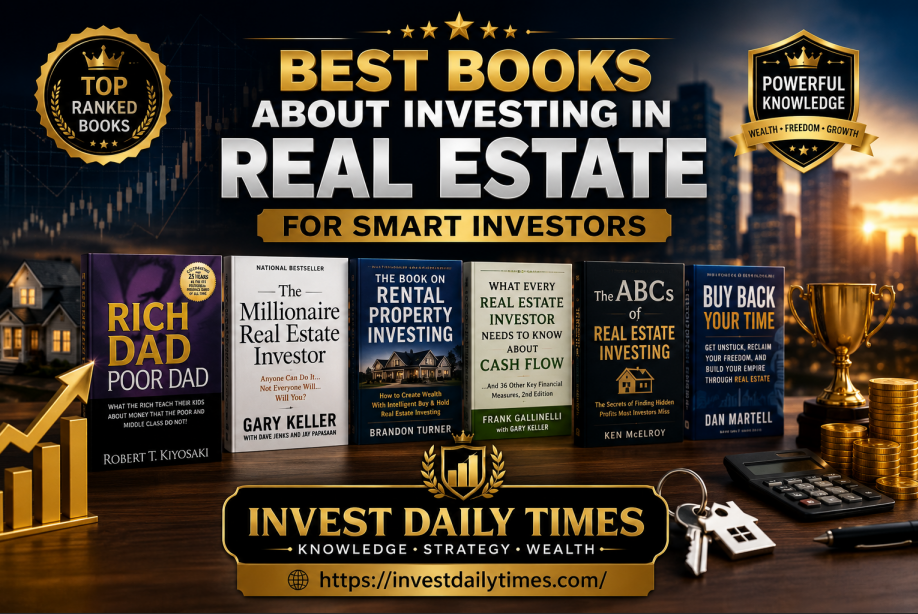
Because they continue to offer useful insights in spite of shifting market conditions, a number of books have gained enduring recognition. The concept underlying asset accumulation and financial independence is introduced in classics like Robert Kiyosaki’s Rich Dad Poor Dad, while Gary Keller’s The Millionaire Real Estate Investor examines tried-and-true strategies used by prosperous investors.
Frank Gallinelli’s What Every Real Estate Investor Needs to Know About Cash Flow describes the financial measures used to assess investment opportunities, while Brandon Turner’s The Book on Rental Property Investing provides comprehensive advice on purchasing and managing rental properties. Investors can also explore reader-rated learning resources to discover additional titles recommended by a broad community of readers with diverse experience levels. When taken as a whole, these resources show why the greatest real estate investment books continue to be important instructional resources for investors looking for long-term success. By reading these books in conjunction with continuing market research, investors can increase their knowledge and confidence and make well-considered judgements based on sound financial concepts rather than conjecture.
Best Books About Investing in Real Estate for Beginners
Because novice investors are exposed to novel concepts like cash flow, capitalisation rates, financing alternatives, appreciation, leverage, rental management, and property valuation, beginning a real estate investing journey might feel daunting. For this reason, choosing the best books about investing in real estate is one of the smartest steps beginners can take before buying their first property. Beginner-friendly publications help readers gain confidence while gaining a solid grasp of how real estate investments operate by simplifying difficult subjects without compromising accuracy. They assist readers comprehend not just what to do but also why each tactic works by outlining the principles in a logical manner. Quality books promote patience, investigation, and methodical decision-making rather than dangerous shortcuts or exaggerated wealth-building claims.
Practical examples, worksheets, and case studies that show how seasoned investors assess opportunities, project costs, and assess possible profits are also included in many beginner-focused tools. These real-world examples assist readers in making the connection between financial ideas and practical investment choices. Beginners can learn how to avoid expensive blunders like overpaying for a property, underestimating renovation costs, ignoring vacancy rates, or selecting poor locations from the best books about investing in real estate. Developing this understanding prior to investing can greatly lower risk and enhance long-term results.
Prioritise books that will assist you if you’re just starting out:
- Recognise the terms used in real estate and the principles of investing.
- Discover how to assess cash flow, expenses, and rental income.
- Gain self-assurance in budgeting, property analysis, and finance.
- Establish reasonable goals for building long-term wealth.
Beginners can approach their first investment with more confidence and a better understanding of how successful real estate investing operates by grasping these fundamental ideas. Once they have built a solid foundation, learning how to get started in real estate investing can help them take the next practical step with greater confidence.
Advanced Best Books About Investing in Real Estate for Experienced Investors
Building a larger and more diverse portfolio requires investors to increase their level of competence after they have grasped the fundamentals. The best books about investing in real estate for advanced readers focus on sophisticated investment methods, commercial real estate, portfolio optimisation, tax planning, market cycle analysis, asset protection, and wealth preservation. These books are intended for readers who are already familiar with the fundamentals and wish to enhance their decision-making skills through more in-depth financial analysis and strategic planning. Advanced materials examine how seasoned investors grow their companies while handling escalating levels of complexity and danger, as opposed to elucidating basic concepts.
Multifamily purchases, commercial property assessment, value-added investing, syndications, partnership arrangements, innovative financing, and economic factors that impact real estate markets are all covered in a number of advanced books. Readers who want to explore apartment buildings and similar income-producing assets can continue with multifamily real estate investing for more detailed guidance. They also place a strong emphasis on developing effective property management systems, carrying out exhaustive due diligence, negotiating significant deals, and safeguarding investment capital in the face of shifting market conditions. The finest real estate investment books at this level encourage readers to consider long-term portfolio performance rather than individual properties.
- Books that address these topics are frequently helpful to seasoned investors.
- Investment strategies for commercial and multifamily properties.
- sophisticated return analysis and financial modelling.
- strategies for asset preservation and tax-efficient investing.
- long-term wealth management and portfolio diversification.
These cutting-edge tools assist investors in strengthening risk management procedures, honing their strategies, and making well-informed choices that promote long-term, sustainable portfolio growth. Investors planning to expand their holdings may also benefit from learning how to create a real estate investment Portfolio to support long-term diversification.
Typical Book Types for Real Estate Investing
The best books about investing in real estate fall into a number of categories, each of which focuses on a distinct set of learning objectives and investment objectives. Knowing these categories makes it easier for readers to choose resources that fit their goals and skill level. While some books focus on commercial properties, house flipping, real estate finance, property management, negotiation, or market analysis, others focus on residential rental investing. Successful investors frequently read about a variety of subjects rather than just one in order to obtain a comprehensive grasp of the sector.
Tenant management, lease agreements, maintenance scheduling, finance, and cash flow optimization are all commonly explained in books on rental property investing. Planning for renovations, budgeting, project management, and reselling tactics are all highlighted in house-flipping books. Larger investment prospects involving office buildings, retail establishments, industrial sites, and apartment complexes are examined in commercial real estate literature. Readers interested in this asset class can further explore how to invest in commercial real estate to better understand the investment process and opportunities.
While market research books educate investors how to recognise prospective neighbourhoods and assess economic trends, finance-oriented literature discuss leverage, mortgages, investment metrics, and capital allocation. Investors can diversify their perspective and adjust to shifting market opportunities by reading a variety of resources that cover different real estate investment strategies.
Among the popular categories are:
- beginner financial education and investing.
- ownership and administration of rental properties.
- investing in commercial real estate.
- renovations and house flipping.
- Analysis of investments and real estate finance.
- strategies for portfolio growth, marketing, and negotiation.
Selecting books from various categories enables investors to get well-rounded knowledge that facilitates more intelligent choices for a variety of real estate investments.
Key Lessons from the Best Books About Investing in Real Estate
The fact that the top real estate investment books consistently impart lessons that are applicable to shifting market situations is one of the reasons they continue to be valuable over time. The fundamental teachings are remarkably stable, even if specific investment opportunities may vary depending on the geography or economic cycle. Rather of making snap decisions or speculating, successful investors place a higher priority on cautious risk management, disciplined financial analysis, extensive research, and long-term thinking. These works consistently show that making wise decisions, exercising patience, and never stopping learning are more important for creating sustainable wealth than pursuing rapid riches.
The significance of comprehending numbers prior to buying any property is another recurrent lesson. Calculating financial flow, estimating running costs, assessing financing costs, calculating return on investment, and accounting for unforeseen repairs or vacancies are among the skills that readers acquire. The importance of developing professional connections with lenders, agents, lawyers, contractors, accountants, and property managers is also emphasised in the greatest real estate investment books. Throughout an investor’s journey, a strong network frequently offers greater chances, insightful market information, and helpful support.
The following are some of the most important lessons readers learn:
- Before making an investment, always conduct thorough due research.
- Prioritise long-term value over transient market enthusiasm.
- Investment risks can be controlled with proper planning and diversification.
- Because successful investment changes as markets do, keep learning.
By regularly putting these ideas into practice, investors may make well-considered choices, safeguard their money, and gradually increase their wealth through long-term, disciplined real estate investing. Investors who want to generate steady cash flow can also explore how to invest in real estate for passive income as a practical next step.
How to Put Real Estate Investment Book Lessons into Practice
To become an informed investor, reading the top real estate books is just the first step. Applying the teachings to actual circumstances yields the most benefit. Many readers complete multiple books but never use what they learn, which reduces the advantages of their education. Make a clear investing plan first, taking into account your available funds, risk tolerance, and financial objectives. Practice evaluating real properties using the techniques described in the books as you research local markets. Determine running costs, compute cash flow, estimate rental revenue, and compare asking prices with previous sales. Regular property evaluations boost your confidence and sharpen your analytical abilities, even if you’re not ready to buy right away.
Instead of depending on sporadic research, the finest real estate books advise investors to form regular practices. Make spreadsheets to monitor possible transactions, go to neighbourhood real estate networking gatherings, talk to seasoned investors, and keep up with market developments in your desired areas. You can obtain real-world experience without taking needless chances by applying your knowledge in tiny, doable steps.
To put knowledge into practice:
- Prior to assessing properties, develop detailed investment criteria.
- Examine actual ads to get experience with financial computations.
- Develop connections with seasoned real estate agents.
- As the market shifts, review and adjust your plan.
Investors can convert theoretical information into real-world experience that promotes long-term financial performance by combining consistent action with ongoing learning.
How to Pick the Best Real Estate Investing Book for Your Objectives
Choosing the best investing book might be difficult because there are thousands of them accessible. The greatest real estate books are those that fit your desired approach, investment goals, and level of experience. Books that provide straightforward explanations of fundamental ideas, financing, property analysis, and investment jargon are frequently helpful to beginners. Books on sophisticated financial analysis, tax methods, portfolio diversification, and commercial real estate may be more appealing to more seasoned investors. Selecting books that align with your objectives guarantees that the knowledge will be useful and immediately relevant.
Look at the author’s experience and background in the real estate sector before buying a book. Instead of depending only on theoretical information, look for authors who have made successful investments under various market conditions. Finding books that offer helpful advice rather than advertising material can also be aided by reading investor reviews and expert-curated reading recommendations from trusted publishers. Real-world examples, case studies, financial computations, and fair treatments of both potential and hazards are often found in the greatest real estate investing books.
Take into account these elements before choosing your next book:
- Your present level of expertise and investing background.
- the particular approach to investing that you wish to understand.
- The author’s practical experience and professional trustworthiness.
- The book’s emphasis on practical guidance as opposed to impractical claims.
By making thoughtful selections, readers can avoid knowledge that might not be relevant to their requirements and create a customized learning path that supports their long-term investing goals. Readers seeking professional guidance may also find real estate investment advisor helpful when developing a long-term investment strategy.
Best Online Resources That Complement the Best Books About Investing in Real Estate
While books offer timeless investment ideas, a more comprehensive learning experience is produced when they are combined with trustworthy online resources. The best books about investing in real estate lay a solid foundation, while online resources keep investors up to date on changing market conditions, economic trends, financing opportunities, legal updates, and emerging investment prospects. Reputable educational websites, trade journals, webinars, podcasts, and real estate investment forums provide valuable insights that complement the knowledge gained from books.
While mortgage calculators and investment analysis tools help estimate returns under different scenarios, online property listing platforms allow investors to practise evaluating opportunities using real market data. Market reports, educational videos, and interviews with experienced investors also provide practical perspectives on current industry developments. However, rather than relying on sensational content or unreliable investment advice, investors should carefully evaluate online information and prioritise credible sources. Because they provide timeless principles that help readers assess the reliability of newer information, these resources continue to be valuable regardless of changing market conditions.
The following are helpful resources to enhance your reading:
- Websites for professional real estate education.
- Economic data and market research reports.
- Calculators for investments and property evaluations.
- Webinars, investor communities, and industry podcasts.
Investors can keep learning while adjusting to shifting market conditions and evolving investment opportunities by combining reputable literature with trustworthy digital resources.
Typical Errors Investors Make Despite Reading Books
Successful real estate investing is not always ensured by reading the best books about investing in real estate. Although many investors are aware of the concepts, many find it difficult to consistently apply them in practical situations. Allowing emotions to take precedence over financial analysis is one of the most common mistakes. Investors may ignore poor cash flow, high renovation costs, limited rental demand, or unrealistic appreciation expectations due to their excitement about buying a property. Even after recognising the importance of thorough research, failing to conduct adequate due diligence before making a purchase is another common mistake.
Additionally, some investors fail to adapt to changing market conditions because they rely too heavily on a single strategy. Successful investors continually expand their knowledge and refine their approach in response to local opportunities and economic trends as markets evolve over time. Instead of encouraging strict adherence to one investment philosophy, these resources emphasise flexibility, patience, and disciplined decision-making. Ignoring these principles can increase financial risk and reduce long-term returns.
Typical errors consist of:
- buying real estate without conducting a thorough financial investigation.
- underestimating the expense of upkeep, repairs, and vacancy.
- failing to properly diversify investments.
- quitting school when only a few books have been read.
Early detection of these errors enables investors to safeguard their wealth, make wiser choices, and gradually enhance their investment performance over time.
FAQS
Which novice real estate investment books are the best?
Some of the greatest books for novice real estate investors include clear, useful explanations of fundamental ideas including property research, financing, cash flow, and long-term wealth development. Seek out books authored by seasoned investors that emphasise education above irrational claims.
Can I become a successful real estate investor just by reading books?
No. Even if the top real estate investment books offer insightful information and tried-and-true tactics, success also necessitates real-world experience, thorough investigation, prudent financial planning, and disciplined decision-making. Books should be paired with ongoing education and real-world analysis.
How many books about real estate investing should I read?
Quantity is not as important as quality. Start by reading a few reputable books on market analysis, rental properties, financial analysis, and investment principles. As you gain experience, move on to more complex subjects that complement your particular investing objectives.
Are older books about real estate investing still applicable?
Because they teach timeless concepts like cash flow management, due diligence, negotiation, and risk assessment, many classic books are still very valuable. These fundamental ideas continue to direct profitable investors even as market conditions shift.
How frequently should I keep learning about investing in real estate?
The real estate market is always changing. You can make well-informed investing judgments and modify your methods over time by reading new books, consulting reputable industry resources, and routinely researching local market trends.
Conclusion
It takes expertise, perseverance, disciplined decision-making, and a dedication to ongoing development to achieve long-term success in real estate. The best books about investing in real estate offer a dependable and reasonably priced way to learn from seasoned investors who have successfully navigated various market conditions and investment challenges. These resources provide practical insights that enable investors to make well-informed decisions with greater confidence, from understanding property valuation and financing to managing risk and building diversified portfolios.
But reading on its own is insufficient. Applying what you learn through meticulous market research, financial analysis, and consistent action yields the best results. A solid foundation for long-term investment success is created by combining the knowledge gained from the best books about investing in real estate with practical experience, reliable online resources, and continuous learning. Throughout your real estate journey, ongoing education will remain one of your most valuable investments, regardless of whether you are buying your first rental property or growing an existing portfolio.
Stay informed with Invest Daily Times for expert recommendations on the best books about investing in real estate, practical investing strategies, market insights, property analysis techniques, and wealth-building knowledge. Follow us on Facebook, Instagram, and Twitter for trusted real estate education, expert guidance, and actionable tips to help you make smarter investment decisions and achieve long-term financial success.













Leave a comment