
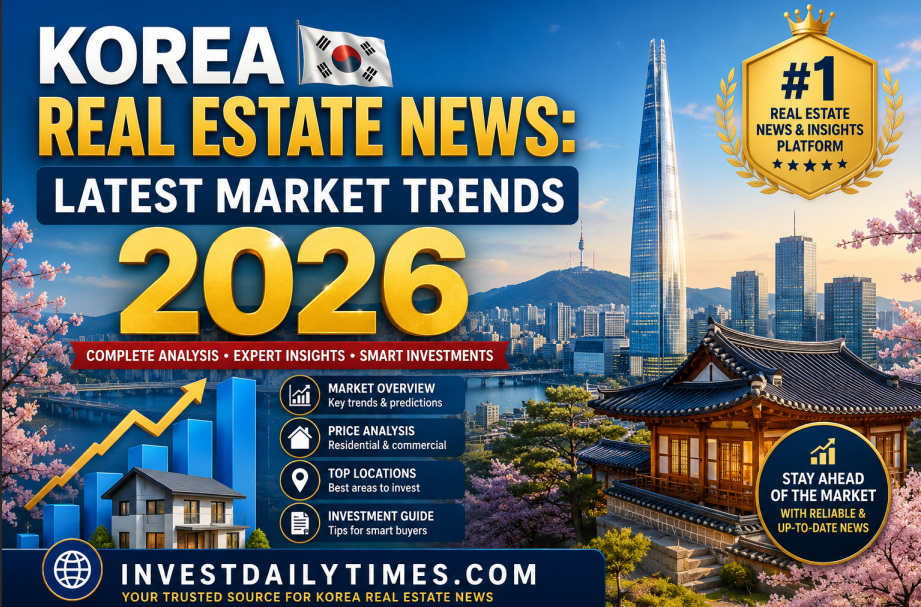
Today we are talking about Korea Real Estate News. As it moves into a new period of adjustment in 2026, South Korea’s real estate market continues to draw interest from investors, developers, homebuyers, and financial analysts. The market is exhibiting signs of increased stability while offering new opportunities across the residential, commercial, and mixed-use sectors after years of price instability, interest rate fluctuations, and government involvement. Understanding the most recent Korea Real Estate News has become crucial for anybody thinking about investing in real estate or keeping an eye on the nation’s housing market as economic conditions improve and investor confidence gradually recovers.
Due to its robust metropolitan infrastructure, sophisticated transit systems, high desire for homeownership, and stable legal system, the Korean real estate market continues to be one of the most widely monitored in Asia. Rapidly growing cities like Busan, Incheon, Daejeon, Daegu, and Jeju are drawing both domestic and foreign investors looking for long-term economic prospects, even while Seoul continues to dominate headlines.
We’ll look at the most recent market trends, economic variables affecting real estate prices, government housing regulations, investment options, and anticipated future market conditions in this extensive guide. This guide offers insightful information about one of Asia’s most dynamic real estate markets, whether you’re buying your first home, growing your investment portfolio, or just keeping up with the most recent Korea Real Estate News.
A Quick Look at the Korean Real Estate Market (2026)
Market Size and Present Performance
One of the biggest economic sectors in South Korea is still the real estate market, which makes a substantial contribution to household assets, financial markets, construction activity, and national wealth, according to official housing market statistics. While commercial real estate, logistical facilities, office buildings, retail complexes, and industrial sites continue to draw institutional investment, residential housing makes up the majority of real estate transactions.
Compared to prior years, market activity has significantly improved in 2026. As purchasers adjust to shifting financing conditions and increasing price stability, transaction volumes have progressively increased in a number of urban areas. Demand is still high in places with robust employment, transit infrastructure, and population density, even though the fast price appreciation seen during previous housing booms has slowed.
Particularly in Seoul’s upscale neighborhoods, where limited supply and steady demand sustain high property values, the luxury housing market has proven particularly resilient. In the meanwhile, redevelopment initiatives funded by the government, advancements in transportation, and an increase in corporate investment are helping regional cities.
Modern office buildings, data centers, logistics hubs, and mixed-use projects have drawn both domestic institutions and foreign investors looking for steady long-term profits, demonstrating the positive performance of commercial real estate.
All things considered, the Korean real estate market in 2026 shows a shift from speculative expansion to a more balanced setting marked by steady demand, solid fundamentals, and enhanced market transparency.
Important Points Investors Need to Know
In 2026, a number of significant trends will influence the Korean real estate market:
As market confidence has improved, there have been more real estate transactions than in prior years.
The most competitive and valuable property market in the nation is still found in Seoul.
Urban renewal and infrastructural growth continue to benefit regional cities.
Due to shifting demographics and worries about affordability, rental demand is still high.
Investment in commercial real estate is growing in mixed-use projects, technology, logistics, and healthcare.
The government’s policies still prioritize more housing supply, stable markets, and affordable housing.
Select residential prospects and high-end commercial assets continue to be the key areas of interest for foreign investors.
Today’s Korean real estate market rewards meticulous study, intelligent location selection, and long-term investment planning rather than seeing rapid price growth across all regions.
What Will Drive the Korean Real Estate Market in 2026?
The housing market in South Korea is influenced by a number of economic, demographic, and policy-related factors. Comprehending these factors aids in elucidating present pricing patterns and prospective investment prospects.
Rates of Interest
One of the key elements influencing Korea’s real estate market is still interest rates. Previous years’ higher borrowing costs hindered the growth of home prices and decreased purchasing activity. However, a lot of potential buyers are progressively coming back to the market as monetary conditions stabilize and borrowing expectations rise.
Households may plan purchases with more confidence when there is less uncertainty about financing, and developers can go forward with new development projects more quickly. Housing demand is still heavily influenced by mortgage affordability, especially for first-time purchasers.
Because house purchases in South Korea usually require substantial financing, even slight changes in borrowing costs can have a large impact on transaction volumes. As a result, when assessing market circumstances, investors keep a careful eye on monetary policy moves.
The rate of inflation
In the real estate industry, inflation has an impact on building expenses as well as property prices. Rising costs for labor, building supplies, electricity, and transportation raise development costs, which frequently result in higher pricing for newly built homes.
However, a lot of investors see real estate as a long-term inflation hedge. During times of high inflation, physical property has typically maintained purchasing power more successfully than many financial assets.
Additionally, developers are focusing more on smart home technology, energy-efficient buildings, and sustainable building practices that lower long-term operating costs while adhering to changing environmental regulations.
In addition to enabling developers to more effectively manage project budgets and investment planning, 2026’s moderating inflation has increased buyer confidence.
Demand for Housing
In South Korea, housing demand is still concentrated in urban areas with the best public amenities, employment prospects, educational institutions, and transportation systems.
There is a steady demand for flats and rental accommodation in Seoul due to the city’s continued appeal to professionals, students, entrepreneurs, and international corporations. Growing commuter infrastructure benefits surrounding metropolitan regions as well, increasing the appeal of suburban life.
Housing preferences are being impacted by shifting household patterns. Compact apartments, mixed-use communities, and handy urban housing with easy access to retail, public transportation, and healthcare are in greater demand due to smaller families, single-person households, and an older population.
Additionally, while raising living standards generally, redevelopment projects that replace older residential areas with contemporary apartment buildings continue to produce new housing supply.
Governmental Regulations
The housing market in Korea is still heavily influenced by national housing policy framework, which aims to improve affordability, expand housing supply, and maintain long-term market stability. Through a variety of regulatory actions, authorities aim to strike a balance between affordability, market stability, sustainable development, and a sufficient supply of housing.
Current policy priorities consist of:
increasing the availability of homes in urban areas with strong demand.
funding programs to assist first-time homeowners.
promoting infrastructure investment and urban renewal.
enhancing the openness of real estate transactions.
encouraging ecologically friendly building methods.
Regulations might occasionally have an impact on investor mood in the short term, but over time, consistent policy execution usually leads to a more stable and robust real estate market.
Current Real Estate News in Korea You Should Be Aware of
According to the most recent Korea Real Estate News, the market is gradually shifting from uncertainty to a slow recovery. The nation’s real estate market in 2026 is being shaped by a number of significant developments, even as the situation of the economy continues to have an impact on consumer behavior.
Significant Market Advancements
In comparison to times of lower market activity, residential real estate transactions have surged in a number of metropolitan areas. As financing circumstances normalize and price volatility declines, buyers are exhibiting renewed confidence.
High-end residential communities with integrated lifestyle facilities, green areas, enhanced energy efficiency, and smart home technology are becoming more and more popular among developers. These characteristics are now significant competitive advantages that draw in contemporary homebuyers.
Institutional investors are still putting money into mixed-use commercial projects that produce comparatively steady long-term revenue, office buildings, logistics facilities, and healthcare facilities.
In the meantime, the process of purchasing a property is becoming more transparent and efficient thanks to digital technologies like artificial intelligence, big data analytics, virtual property tours, and online transaction platforms.
Projects for New Housing
To meet the ongoing demand for housing, a number of residential projects are moving forward in Seoul and the surrounding metropolitan areas.
Large-scale rehabilitation projects are swapping out outdated apartment buildings for contemporary residential neighborhoods with better public facilities, parks, transit, and infrastructure.
More and more developers are adding sustainable elements, such as:
Systems for energy-efficient buildings
Intelligent security systems
Infrastructure for charging electric vehicles
Workspaces for the community
The use of green landscaping
Intelligent building management systems
These initiatives are intended to meet national sustainability goals while simultaneously increasing the availability of housing and enhancing the general quality of life for inhabitants.
Announcements of Policy
Policymakers who want to increase affordability and preserve market stability continue to place a high priority on housing policy.
Current initiatives keep highlighting:
accelerating the building of homes.
promoting the supply of homes in areas with strong demand.
updating the infrastructure of cities.
promoting the redevelopment of older communities.
simplifying some development and planning procedures.
Government organizations keep a careful eye on market conditions and modify housing plans in response to changing economic situations.
Because regulatory changes can have a substantial impact on financing conditions, taxes, housing supply, and long-term investment success, buyers and investors must keep up with policy developments.
Investing Activities
The property market in South Korea has seen an increase in the diversity of investment activities.
Infrastructure-related projects, office buildings, logistical facilities, and healthcare properties continue to attract the attention of domestic institutional investors. High-end commercial properties in important business districts with robust tenant demand continue to attract interest from foreign investors.
Additionally, residential investment is still appealing, especially in areas with dependable transportation, robust job growth, well-established educational institutions, and current reconstruction projects.
Fundamentals, such as rental demand, infrastructure quality, demographic trends, and economic resiliency, are becoming more important to long-term investors than short-term price speculation.
Therefore, according to the most recent Korea Real Estate News, the market is about to enter a more mature phase when quality developments, sustained growth, and wise investment choices are anticipated to be more important than just quick price appreciation.
Updates on the Seoul Real Estate Market
With the highest property values, strongest buyer demand, and greatest concentration of economic activity in the nation, Seoul continues to be the hub of South Korea’s real estate market. Seoul continues to draw professionals, students, entrepreneurs, and international corporations as the country’s capital and financial center, generating steady demand for both residential and commercial real estate. After a period of adjustment, the market is now more stable in 2026, with purchasers prioritizing long-term value above short-term speculation.
Because they have access to business hubs, prestigious institutions, medical facilities, and public transit, well-connected areas continue to fetch high prices. By replacing outdated apartment buildings with contemporary residential communities with smart technologies, enhanced facilities, and energy-efficient designs, redevelopment projects in older neighborhoods are also boosting market activity.
The rental market is still very busy because many residents are choosing to lease rather than buy a property right away due to rising home costs and shifting lifestyle preferences. Seoul’s restricted land supply and steadily high housing demand make it one of the nation’s most resilient markets, according to investors.
Seoul continues to be one of Asia’s most appealing long-term real estate markets for both homeowners and investors seeking stability, even though future price rise is anticipated to be more moderate than during prior housing booms.
Prices for Apartments
Due to high demand and constrained supply, Seoul’s apartment prices continue to surpass those of many other areas. While new redevelopment regions are drawing customers looking for greater affordability and long-term value, premium districts continue to have high prices.
Because they provide contemporary floor plans, smart home technologies, better security systems, energy-efficient construction, and superior community services, newly built apartment complexes typically fetch higher prices.
Quality developments close to schools, business districts, job centers, and metro stations are now preferred by buyers. Even in times when market growth is sluggish, these factors sustain property values.
Apartments in established areas continue to be among the most desirable residential assets in the nation, despite the fact that annual price rises have become more moderate.
Luxurious Residences
Despite wider market volatility, Seoul’s luxury housing sector continues to show resiliency. In prominent neighborhoods, high-net-worth individuals, corporate executives, and foreign investors continue to buy upscale flats and special residential homes.
The emphasis on seclusion, cutting-edge building technology, concierge services, wellness centers, private workout centers, and high-end architectural design is growing in luxury complexes.
The long-term value of luxury properties is also influenced by the scarcity of land in central Seoul. The demand for high-quality homes continues to support premium prices as supply is still limited.
In Korea’s residential real estate market, luxury housing continues to be one of the most reliable categories for long-term investors.
Demand for Rentals
Due to issues with affordability, population mobility, and ongoing urbanization, rental demand is still very high throughout Seoul.
Young professionals, college students, recently married couples, and foreigners are still looking for rental properties near job hubs and transit systems. Mixed-use complexes, serviced homes, and compact flats are still very popular.
Tenant choices have also been impacted by increased flexibility in employment arrangements. Nowadays, a lot of tenants give preference to homes with dedicated workstations, fast internet, and easy access to lifestyle activities.
Rental properties continue to be a desirable investment choice for property owners looking for steady recurring income due to consistent occupancy rates.
Outlook for the Future
Despite continuous economic uncertainties, Seoul’s real estate market has a promising long-term future.
Continued redevelopment projects, increased mobility, smart-city initiatives, and consistent demand from both domestic and foreign consumers will probably support future growth.
The market is anticipated to grow at a healthier rate marked by sustainable demand, better housing quality, and stronger investment fundamentals rather than seeing sharp speculative price spikes.
Seoul still has one of the best real estate markets in South Korea for investors looking for long-term gain and rental income.
South Korea’s Fastest-Growing Real Estate Markets
A number of regional cities are seeing substantial real estate growth as a result of infrastructural investment, industrial expansion, tourism development, and population relocation, despite Seoul dominating national news. For investors looking to diversify beyond capital, these rising markets have appealing prospects.
Busan
Busan, the second-biggest city in South Korea, keeps enhancing its standing as a major hub for commerce, logistics, and tourism.
The demand for both residential and commercial buildings has surged due to ongoing waterfront renovation, improved transit, and growing international corporate activity. Investors continue to favor upscale beachfront residences, mixed-use projects, and hotel properties.
Long-term economic growth is further supported by Busan’s developing port infrastructure and burgeoning technology sector, which makes the city a desirable location for real estate investment.
Incheon
As one of the main hubs for logistics and transportation in Northeast Asia, Incheon continues to profit from its advantageous location close to Seoul.
Housing demand has increased due to large-scale urban development projects, contemporary residential communities, and growing commercial districts. Good transportation connections, such as access to international airports, continue to draw both inhabitants and businesses.
Because Incheon offers substantially higher affordability while retaining strong long-term growth potential, investors are beginning to see it as a viable option to Seoul.
Daegu
Daegu’s real estate market is still changing as a result of urban redevelopment, healthcare investment, and industrial modernization.
The demand for housing is steadily rising due to new residential developments, enhanced transportation systems, and company growth. Investors value Daegu’s comparatively inexpensive entry costs and better economic outlook, even though prices are still lower than in Seoul.
Long-term development is nevertheless supported by the city’s expanding innovative industries and manufacturing base.
Daejeon
One of South Korea’s top cities for technology and research is Daejeon.
The steady need for accommodation among professionals, scholars, and students is influenced by government agencies, academic institutions, and research groups. Growth in residential and commercial real estate is supported by ongoing investment in the research and technology sectors.
Modern apartment buildings and mixed-use constructions continue to be especially appealing in the city’s growing urban areas.
Jeju
Jeju’s tourism-driven economy and appealing lifestyle make it stand out in South Korea’s real estate market.
Both domestic and foreign purchasers are still drawn to vacation houses, resort complexes, hospitality investments, and exclusive residential communities. High-quality living conditions and picturesque coastline settings support the continuous demand for real estate.
Jeju continues to present appealing options for investors interested in hospitality and lifestyle-focused real estate, despite the fact that travel trends may have an impact on market activity.
Trends in Property Prices in Korea (2026)
Depending on factors including location, type of property, redevelopment activity, and economic conditions, South Korean real estate values differ significantly. In contrast to speculative investment, real housing demand is driving more balanced growth in the majority of market categories in 2026.
Prices for Apartments
In South Korea, apartments continue to be the most popular kind of residential real estate.
Demand is still highest in cities with concentrated public services, economic prospects, transportation infrastructure, and educational institutions. Because of their contemporary features and increased energy efficiency, newly built developments typically command premium pricing.
Additionally, by substituting modern apartment complexes for older homes, redevelopment projects continue to raise the value of the surrounding neighborhoods.
Apartments in good metropolitan areas are still excellent long-term investments, even though annual appreciation has slowed.
Prices for Villas and Houses
Although they make up a lower portion of Korea’s residential market, villas and detached homes are nonetheless crucial for families looking for greater living areas.
The quality of the area, accessibility, possibility for redevelopment, and infrastructure availability all have a significant impact on price performance. Improved transportation connections in some suburban areas have made it easier to commute to important job hubs.
Buyers looking for alternatives to high-rise apartment living are still drawn to contemporary single-family developments that emphasize sustainability, privacy, and smart-home technologies.
Prices for Commercial Properties
Long-term economic activity and shifting consumer behavior continue to make commercial real estate an appealing investment category.
While logistics facilities profit from ongoing growth in e-commerce and supply chain infrastructure, modern office buildings in desirable business districts continue to see strong tenant demand.
Location and tenant quality have an impact on retail property performance, with mixed-use complexes typically outperforming conventional freestanding retail formats.
Institutional investors looking for steady long-term income continue to be drawn to healthcare facilities, technological campuses, and industrial logistics assets.
Top Locations for Korean Real Estate Investments
Infrastructure, economic growth, rental demand, redevelopment activity, and long-term demographic trends must all be considered when choosing an investment location.
Investing in Homes
Residential investors typically concentrate on regions with steady population growth, dependable transit, top-notch educational institutions, and growing job possibilities.
While towns like Incheon, Busan, and Daejeon continue to draw purchasers looking for long-term appreciation and relatively cheaper entry prices, Seoul continues to be the nation’s top residential market.
Additionally, because community improvements frequently contribute to future increases in property values, redevelopment areas present appealing options.
Business Investment
Office buildings, logistics hubs, medical facilities, technology parks, and mixed-use projects are becoming more and more popular targets for commercial investors.
Long-term stability is often highest in business districts that are bolstered by robust transit infrastructure and expanding employment.
Investors are increasingly diversifying across a number of commercial real estate sectors that profit from structural economic growth rather than depending only on traditional office space.
Investing in Rental Properties
In the main cities of South Korea, demand for rental accommodation is still steady.
Smaller households, university students, young professionals, and expats all frequently need high-quality rental housing close to job hubs and transit systems.
Stronger occupancy rates and more steady rental income are usually seen in properties near major commercial districts, universities, technology parks, and subway stops.
Rental properties in well-established metropolitan districts, where long-term tenant demand remains stable despite short-term market volatility, are frequently given priority by investors looking for consistent cash flow.
The Housing Market in Korea is Shaped by Government Policies
One of the biggest factors influencing South Korea’s real estate market is still government policy. Policymakers frequently implement policies meant to strike a balance between affordability, financial stability, and sustainable urban development rather than letting the housing market function solely on the basis of market forces. Increasing the supply of homes, assisting first-time homeowners, promoting redevelopment, and enhancing transparency in real estate transactions are still the main priorities in 2026.
In regions where housing demand continuously outpaces supply, one of the government’s main goals is to increase residential building. The goal of infrastructure improvements, urban renewal initiatives, and new town developments is to improve living conditions in existing communities while reducing long-term housing shortages.
Policies related to housing finance are also crucial. In order to lower excessive household debt while maintaining adequate access to finance for qualified buyers, authorities are nonetheless keeping an eye on mortgage lending criteria. Younger households and qualified first-time buyers are also assisted in entering the real estate market by a number of support programs.
Another policy goal now is sustainability. Energy-efficient construction, eco-friendly building materials, smart-city technologies, and enhanced public transportation links are all becoming more and more important in new constructions.
Because regulatory changes can affect transaction costs, finance availability, redevelopment opportunities, and long-term property values, it is crucial for investors to understand government policies.
Foreign Real Estate Investment in Korea
South Korea’s sophisticated economy, open legal system, cutting-edge infrastructure, and secure banking system continue to draw in foreign investors. Premium residential properties, office buildings, logistical facilities, hotels, and mixed-use developments continue to pique the interest of foreign buyers, despite the fact that foreign involvement is lower than domestic investment.
Can Foreigners Purchase Real Estate?
Indeed. In general, foreign businesses and individuals are able to buy real estate in South Korea. Foreign buyers can purchase both residential and commercial properties, but transactions must adhere to applicable tax rules, foreign exchange regulations, and reporting requirements.
In many property categories, foreign investors’ ownership rights are essentially the same as those of Korean nationals. However, some transactions involving national security considerations, properties situated in specified areas, or purchases of land may need extra permissions or be subject to particular regulatory restrictions.
Before finalizing any deal, foreign investors should consult with licensed real estate brokers, tax experts, and skilled legal specialists because regulations are subject to change.
Guidelines and Limitations
Before making an investment, foreign buyers should thoroughly comprehend a number of crucial factors:
Purchases of real estate must adhere to Korean registration regulations.
Depending on the ownership structure and investment goal, different tax obligations apply.
The financing alternatives offered to domestic buyers may not be the same for non-residents.
Prior to moving investment funds, currency exchange restrictions should be examined.
Korean taxes may apply to capital gains and rental income.
Before buying a property, conducting enough due diligence helps reduce financial and legal risks while guaranteeing adherence to local laws.
Possibilities for Investment
In 2026, a number of industries are still drawing in foreign capital.
Due to steady tenant demand and long-term leasing potential, commercial office buildings in important business districts continue to be desirable. While hospitality assets in popular tourist locations continue to attract investor attention as international travel grows, logistics facilities profit from the ongoing expansion of e-commerce and supply chain modernization.
There are residential investment opportunities in high-demand rental markets, redevelopment districts, and upscale neighborhoods where long-term fundamentals are still favorable.
In general, foreign investors that place a higher priority on long-term economic growth, infrastructure, rental demand, and location quality are better positioned for sustainable returns than those who engage in short-term market speculation.
Significant Obstacles in Korea’s Real Estate Market
The housing sector in South Korea is nevertheless impacted by a number of structural and economic issues despite better market circumstances.
One of the biggest issues facing the nation is still housing affordability. Many younger purchasers find it challenging to become homeowners in Seoul and the neighboring metropolitan areas due to the high cost of real estate compared to household income.
Longer-term demographic issues include an aging population and a falling birth rate. While big urban hubs continue to draw residents through economic and educational opportunities, certain rural communities may see slower growth as a result of population shifts.
Household debt is still a significant factor. During times of monetary policy adjustment, purchasers may be particularly sensitive to changes in mortgage interest rates due to higher borrowing levels.
Because of labor prices, building materials, and environmental regulations, construction costs are still higher than they were in prior years. These increased development expenses may restrict the expansion of the housing supply or raise the cost of recently finished homes.
Investment success is also inconsistent due to regional variances. Some smaller regional markets may grow more slowly due to local economic conditions and demographic patterns, while Seoul and major urban areas continue to have relatively robust demand.
Investors must concentrate on market fundamentals rather than transient price changes in order to successfully navigate these obstacles.
Forecast for the Korean Real Estate Market (2026–2030)
In contrast to the sharp price increases observed during prior housing cycles, the majority of economists predict that South Korea’s real estate market would grow moderately and sustainably in the future.
Seoul, the surrounding metropolitan area, and other economically thriving cities backed by job growth, transportation infrastructure, and educational institutions are predicted to continue to have the highest residential demand.
Through 2030, urban redevelopment projects will probably continue to be a significant source of investment activity. It is anticipated that the replacement of outdated housing stock with contemporary apartment buildings will enhance community character and raise long-term property values in particular neighborhoods.
Growing technological sectors, the need for logistics, investments in healthcare, and mixed-use projects that cater to evolving workplace and lifestyle tastes should all continue to benefit commercial real estate.
Technology will change the industry as well. It is anticipated that modern construction technologies, digital property platforms, smart buildings, automated property management, and artificial intelligence would increase market efficiency while lowering operating costs.
The overall picture points to a stable market underpinned by robust infrastructure, continuous urban investment, and careful regulatory monitoring, even though short-term swings are still likely owing to economic conditions or global financial developments.
Professional Forecasts for Korean Real Estate Investors
Instead of trying to profit from short-term market swings, real estate experts typically advise implementing a long-term investment strategy.
The most crucial aspect of investing is still location. Over time, it is anticipated that areas with growing transit networks, significant redevelopment initiatives, robust job possibilities, and first-rate educational institutions will perform better than less developed areas.
It is anticipated that rental properties will continue to be a desirable area for investment. Consistent rental demand is supported in many metropolitan regions by ongoing urbanization, shifting household patterns, and issues with housing affordability.
Instead of concentrating only on typical office space, commercial investors are increasingly concentrating on industries underpinned by structural economic trends. It is anticipated that in the upcoming years, mixed-use complexes, healthcare facilities, logistics facilities, and technology campuses would continue to be among the asset groups with the best performance.
Additionally, experts stress the significance of diversification. Combining income-producing, commercial, and residential properties from various areas may lower portfolio risk while increasing long-term profits.
In the end, investors who make judgments based on infrastructural development, demographic trends, and economic fundamentals are likely to produce better long-lasting outcomes than those who are largely motivated by short-term market sentiment.
In 2026, is real estate in Korea a wise investment?
Despite continuous market changes, South Korea nevertheless has appealing long-term prospects for many investors.
A strong basis for long-term real estate investment is provided by the nation’s robust economy, highly developed infrastructure, open legal system, sophisticated transportation network, and fiercely competitive technology industry.
While commercial real estate offers potential in logistics, healthcare, technology, and mixed-use developments, residential markets continue to profit from sustained demand in large urban regions.
Instead of believing that every site will do equally well, successful investing necessitates thorough investigation. Before making investment selections, it is important to consider a number of factors, including government policy, local employment growth, redevelopment activity, transit upgrades, rental demand, and financing costs.
In general, investors that have a long-term outlook, reasonable expectations for returns, and diligent due diligence are better positioned to profit from South Korea’s developing real estate market.
The general forecast indicates that correctly chosen Korean real estate assets can continue to offer both capital appreciation and steady income opportunities throughout time, even if no investment is risk-free.
FAQs
What prospects does Korea’s real estate market currently have for 2026?
It is generally anticipated that the market would stay constant, with modest expansion bolstered by rising buyer confidence, infrastructure investment, urban redevelopment, and consistent demand for homes in large cities.
Is investing in Seoul still the greatest option?
Because of its economic significance, transportation system, job prospects, and steady home demand, Seoul continues to be one of South Korea’s most robust real estate markets. Investors should, however, also consider new prospects in other developing cities.
Can foreigners buy real estate in South Korea?
Indeed. As long as they abide by the relevant legal, tax, registration, and reporting requirements, foreign buyers are typically authorized to purchase residential and commercial real estate.
Which real estate industry provides the greatest chances for investment?
Investment objectives determine the response. Long-term demand is provided by residential flats, while institutional investors are still drawn to mixed-use complexes, luxury office space, healthcare facilities, and logistics facilities.
Which dangers are the most significant for investors?
Interest rate fluctuations, changes in government policy, demographic shifts, regional market disparities, building prices, and general economic conditions are some of the major hazards.
Conclusion
After years of economic uncertainty and policy changes, the market is progressively moving toward greater stability, according to the most recent Korea Real Estate News. The fundamentals of South Korea’s real estate market are still solid despite the slowdown in price growth, thanks to the country’s robust economy, high urban demand, contemporary infrastructure, and ongoing renovation.
In a market marked by increasing openness and balanced growth, buyers now have the chance to make better-informed purchases. Instead than depending on short-term speculation, investors can gain from concentrating on areas with robust demographic trends, growing transportation networks, and long-term development prospects.
South Korea’s sophisticated economy, open legal system, and varied real estate industries continue to make it a desirable location for foreign investors. In the meantime, the market is anticipated to grow in the upcoming years due to continued government initiatives to increase the supply of housing and promote sustainable urban development.
The most crucial elements for success will continue to be methodical research, thorough due diligence, and a long-term investing perspective as the market changes between 2026 and 2030. Investors and purchasers may make confident judgments and position themselves to profit from South Korea’s vibrant and continually growing real estate market by keeping up with the most recent Korea Real Estate News.
Invest Daily Times, your reliable source for up-to-date Korea real estate news, professional market insights, housing policy updates, and in-depth investment research, may help you make wiser real estate investment selections. To remain up to date on new possibilities, market trends, and changes influencing South Korea’s vibrant real estate industry, follow us on Facebook, Instagram, and Twitter.










Leave a comment