

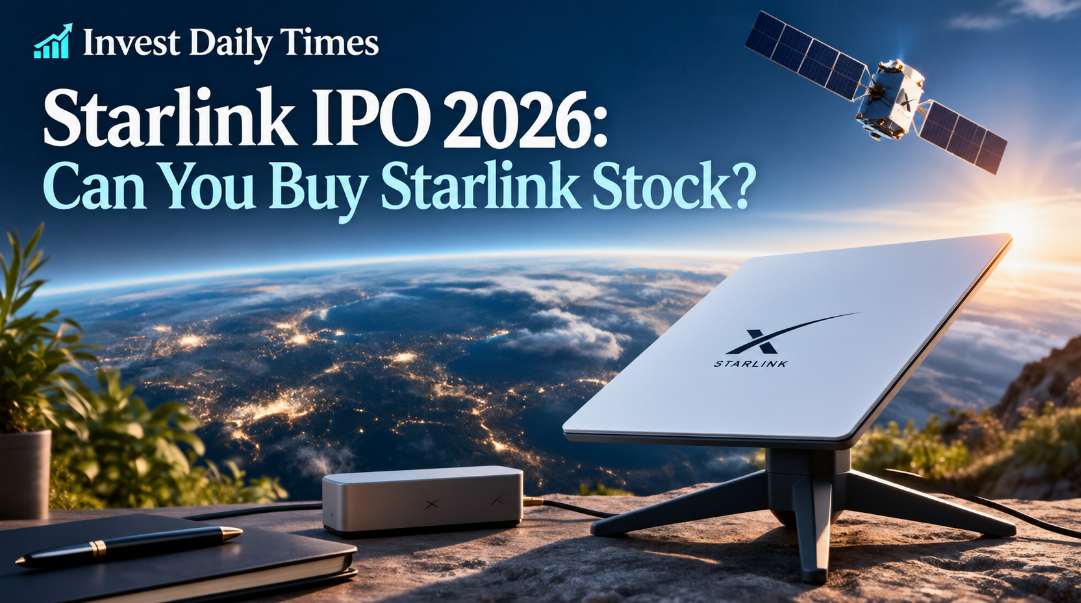
Starlink has become a major name in satellite internet, offering connectivity in places where traditional broadband infrastructure can be difficult or expensive to establish. Its potential to serve households, businesses and remote locations has attracted attention from customers and investors alike. But for people interested in the space industry, one question remains particularly important: can you buy Starlink stock, or do you need to invest in its parent company?
The answer starts with an important distinction. SpaceX completed its initial public offering in June 2026, and its Class A shares began trading under the ticker symbol SPCX. Starlink, however, operates within SpaceX. The parent company’s listing does not automatically create a separate publicly traded Starlink stock.
This matters because investing in SpaceX means gaining exposure to the broader company, rather than buying shares in a separately listed satellite internet business. Its other operations, capital requirements, financial results and market valuation can all influence the investment.
For anyone researching the Starlink IPO, the priority is to distinguish confirmed developments from speculation about a possible future listing. Understanding the current ownership structure, the available public-market route and the risks associated with private-market offers can help investors make better-informed decisions.
Starlink IPO Status in 2026: What Is Confirmed?
SpaceX completed its public offering in June 2026. However, the official sources reviewed for this article do not confirm a separate Starlink listing date or an independent Starlink stock ticker as of October 12, 2026.
On June 11, 2026, SpaceX announced that it had priced its offering at $135 per share. The company’s Class A common stock was scheduled to begin trading under the symbol SPCX on June 12. SpaceX subsequently announced on June 15 that the offering had closed, including the underwriters’ full additional-share option.
The details are available in the company’s official pricing announcement and closing announcement.
These documents confirm the parent company’s completed offering. They do not establish that Starlink has its own public shares or a separate listing date.
Confusion often arises because articles use the names SpaceX and Starlink interchangeably. Although the two are closely connected, they are not interchangeable investment securities. Starlink is part of SpaceX, so its business performance can affect the parent’s prospects, but shareholders in SpaceX own an interest in the overall company.
Investors should be cautious when websites or social media posts describe a future listing as confirmed without pointing to a reliable company announcement or relevant regulatory filing. A prediction about a possible listing is not the same as an official decision.
Does Starlink Have Its Own Stock Ticker?
No separate Starlink ticker has been confirmed in the official sources reviewed for this article. SpaceX’s publicly traded Class A shares use the ticker symbol SPCX.
The distinction is straightforward: buying shares in a parent company is different from buying shares in one of its individual businesses.
Here is the current position:
- Publicly traded parent company: SpaceX
- SpaceX ticker: SPCX
- Original offering price: $135 per share in June 2026
- Separate Starlink stock: No separate publicly traded security was identified in the official sources reviewed
- Separate Starlink listing date: No confirmed date was identified
The $135 figure is the original offering price, not the current market price. Shares can trade above or below their initial offering price after listing, so investors should check a current market quotation before making any decision.
It is also important to distinguish the valuation of SpaceX as a whole from the value of Starlink on its own. SpaceX operates multiple business activities, and its share price reflects market expectations for the parent company rather than only the satellite internet operation.
Readers who want to explore related public-market topics can browse the stock market research section for additional investment and market coverage.
How Can Investors Get Exposure to Starlink?
For investors looking for public-market exposure to the company that operates Starlink, SpaceX shares are the relevant starting point. However, buying SPCX means investing in the parent company, not purchasing a separately listed Starlink security.
The difference matters when assessing potential returns. Starlink’s performance may influence the company’s prospects, but SpaceX’s valuation can also reflect its other operations, financial commitments, technology development and spending plans.
Investors who want to understand the available routes to buying shares can read our guide on how to invest in SpaceX. It explains the public-market access and broader considerations involved in evaluating the company.
Before investing, consider several factors.
The wider business: SpaceX is not solely a satellite internet provider. Its overall performance may reflect multiple business areas, so it is important to evaluate the parent company rather than making a decision based only on expectations for Starlink.
Share valuation: A business can have attractive technology and significant growth opportunities while still being an expensive investment. Investors should compare the market valuation with the company’s financial performance, future spending requirements and realistic growth expectations.
Capital requirements: Satellite networks need continuing investment in satellites, launches, ground infrastructure and service capacity. Expansion can create opportunities, but it also requires substantial spending.
Competition and regulation: Internet providers operate in markets shaped by pricing, coverage, local approvals and competing technologies. These factors can influence demand and the cost of entering new markets.
Personal risk tolerance: Publicly traded stocks can experience significant price movements. Investors should consider their financial goals, investment horizon and ability to withstand losses before buying shares.
A careful review of company disclosures is more useful than relying on headlines, optimistic predictions or the possibility of a future listing.
What Should You Check Before Buying Private-Market Shares?
Investors searching for early access to high-profile companies may encounter websites advertising private-market shares or pre-listing investment opportunities. Such offers require careful review because the wording alone does not establish what the buyer would own.
An offer might involve shares in a private entity, an interest in a special-purpose vehicle or another contractual arrangement. These structures can have different ownership rights, fees, restrictions and risks.
Before transferring money, establish exactly what the provider is offering.
Verify the security and ownership rights
Ask for the issuer’s full legal name, the type of security being sold, the seller’s authority to transfer it and the documentation explaining the ownership structure. Confirm whether the arrangement gives you direct share ownership or only an indirect economic interest.
Do not assume that a product represents direct ownership simply because a website uses a familiar company name.
Check the provider’s regulatory status
Verify the platform’s legal identity and determine which regulator, if any, oversees its activities. Check whether it is authorized to offer the specific investment in your jurisdiction and whether eligibility restrictions apply.
A professional-looking website or positive online reviews are not proof that an investment is legitimate.
Understand fees and exit restrictions
Private-market investments can be difficult to sell. Depending on the structure, there may be commissions, transfer restrictions, holding periods or other costs. Ask how an exit would work, who determines the valuation and whether you could be required to hold the investment longer than expected.
You should also understand what happens if a proposed listing is delayed or never occurs.
Be cautious of guaranteed returns
No future listing or investment return should be treated as certain. Be wary of promises of guaranteed profits, pressure to pay immediately or claims of official endorsement without supporting documentation.
The SEC’s investor education resources provide general guidance on assessing investment opportunities and recognizing potential fraud. They can support your research, although they do not replace professional advice about a specific transaction.

What Could Support Starlink’s Future Business Growth?
The long-term outlook for satellite internet depends on whether providers can meet customer needs while managing the technical and financial demands of their networks. For Starlink, the potential opportunity extends beyond areas where traditional broadband is already widely available.
However, a large potential market does not automatically translate into sustainable profits. The commercial outcome depends on pricing, customer demand, network capacity, operating costs and competition.
Demand in underserved locations
Satellite internet can offer an alternative in rural communities, remote workplaces and other locations where building terrestrial infrastructure is difficult or expensive. Customers in these areas may value connectivity where conventional options are limited.
The business case still depends on affordability and service quality. Equipment costs, subscription prices and network performance can influence whether customers sign up and continue using the service.
International expansion
Entering new countries can increase the potential customer base, but market access is not automatic. Providers may need to satisfy licensing conditions, spectrum requirements, security rules and other local operating standards.
India illustrates these challenges. In an October 11, 2026, Reuters report on India’s satellite internet market, Elon Musk said the service would need affordable pricing to compete with established providers such as Reliance Jio. Reuters also reported that satellite ventures were awaiting final security clearance.
The report provides useful context about potential market expansion. It does not establish a separate listing or confirm that commercial service has launched in India. The actual business impact will depend on regulatory decisions, pricing and execution.
Competition from other internet technologies
Satellite internet competes with several forms of connectivity, including fiber broadband, fixed wireless and mobile networks. The relative strength of each option varies by location and customer need.
In some areas, satellite service may be practical where alternatives are limited. In others, terrestrial providers may offer lower prices or different performance advantages. Investors should not assume that satellite technology will replace existing networks in every market.
Network Investment, Operating Costs and Financial Performance
Satellite networks require ongoing investment in launches, satellites, ground infrastructure and customer equipment. SpaceX’s second-quarter 2026 SEC filing provides useful context for evaluating its connectivity business. For the quarter ended June 30, 2026, the Connectivity segment reported $4.291 billion in revenue, up from $2.588 billion in the same quarter of 2025. Its operating income increased from $923 million to $1.656 billion over the same period.
These figures reflect SpaceX’s broader Connectivity segment, not Starlink’s consumer internet service alone. They offer evidence of the segment’s financial performance, but investors should also consider capital spending, operating costs, competition and future funding needs. Revenue growth by itself does not establish whether a stock is fairly valued or whether the business will sustain its profitability.
Could Starlink Have a Separate Listing in the Future?
A separate listing is a possibility that investors may discuss, but it should not be treated as a confirmed corporate plan without reliable official evidence.
Companies can raise capital through a parent company, reorganize their operations, sell a business division or consider a separate listing. The right approach depends on strategic priorities, financial needs, corporate structure, legal requirements and market conditions.
If a separate listing is announced, investors should look for documentation identifying the proposed issuer and explaining the offering. Depending on the structure, relevant information could include an official company announcement, regulatory filings, an offering prospectus, share-class details and financial disclosures.
A prediction about a future listing is not the same as a formal decision. Older articles can remain online after their forecasts become outdated, so readers should check publication dates and confirm claims against primary sources.
Even if a separate offering is eventually announced, investors would still need to evaluate the proposed valuation, financial performance, capital requirements, competitive position and risks. A well-known brand or high level of public interest does not guarantee attractive investment returns.
Until reliable documentation establishes otherwise, investors should distinguish between the existing public-market route through SpaceX and the possibility of a future separate listing.
How to Evaluate SpaceX and Starlink Before Investing
Before investing in a business connected to Starlink, it is important to understand what you are actually buying. Starlink operates as part of SpaceX, so buying SpaceX shares provides exposure to the parent company and its broader operations—not a separate investment in Starlink alone.
Investors should look beyond the company’s technology and growth potential. Review its reported revenue, operating costs, cash flow, capital spending and financial risks. For Starlink, this also means considering the expense of expanding satellite coverage, maintaining its network, upgrading equipment and competing with other internet providers. Strong demand does not automatically translate into higher profits or make a stock worth any price.
Valuation matters just as much as business performance. A company’s share price reflects expectations about its future, and investors can lose money when those expectations prove too optimistic. Our analysis of Tesla’s intrinsic value and stock valuation explains why revenue growth, future cash flow and investment requirements all matter when assessing what a business may be worth.
For a broader framework, explore our stock evaluation guides. When researching SpaceX, use its official financial disclosures and distinguish company-wide results from figures specifically attributable to Starlink. This helps you assess the business more accurately and understand the risks before making an investment decision.
FAQs
Is Starlink going public in 2026?
SpaceX completed its public offering in June 2026, but a separate Starlink listing date has not been confirmed in the official sources reviewed for this article as of October 12, 2026. The parent company’s listing should not be described as a separate Starlink offering.
What is the Starlink stock ticker?
No independent ticker for a separately listed Starlink company has been confirmed in the official sources reviewed. SpaceX’s publicly traded Class A shares use the symbol SPCX.
Can I buy Starlink stock today?
There is no separate publicly listed Starlink stock identified in the official sources reviewed. Investors can research SpaceX shares under SPCX through a brokerage that supports access to the relevant market. Availability, fees and eligibility depend on the broker and the investor’s jurisdiction.
What was the SpaceX IPO price?
SpaceX announced an offering price of $135 per share in June 2026. This is the historical offering price, not a current market quote or a recommendation to buy. Check current pricing and company disclosures before making an investment decision.
Are private-market offers connected to Starlink legitimate?
The answer depends on the specific provider, security and legal structure. Verify the issuer, ownership rights, regulatory status, fees, transfer restrictions and exit terms. Marketing language alone does not establish that an offer provides direct ownership in a particular company.
Will Starlink eventually have its own listing?
That remains uncertain unless supported by an official announcement or relevant regulatory documentation. Investors should not rely on predicted dates or assume that a separate offering is inevitable.
Is SpaceX stock the same as Starlink stock?
No. SpaceX shares represent ownership in the parent company and its wider business. Starlink is part of that business, so its performance may influence the investment case, but SPCX is not a separate Starlink security.
Final Thoughts
The key point for investors is that SpaceX completed its public offering in June 2026, while a separate Starlink listing has not been confirmed in the official sources reviewed for this article.
SpaceX shares under SPCX provide public-market exposure to the parent company, not exclusive ownership of its satellite internet business. Investors should consider the company’s broader operations, financial disclosures, capital requirements, competitive environment and market valuation before deciding whether the shares fit their goals.
Private-market offers require additional care because the underlying security, ownership rights and ability to sell may differ from what the marketing suggests. Verify the documentation, understand the risks and avoid treating a potential future listing as a guaranteed outcome.
The most reliable approach is to base investment decisions on current, verifiable information rather than speculation. That remains true whether an investor is considering publicly traded shares today or watching for a possible corporate development in the future.
Disclaimer: This article is for informational and educational purposes only. It does not constitute financial, investment or legal advice, and it is not a recommendation to buy or sell any security. All investments involve risk, including the possible loss of capital. Conduct independent research and consider consulting a qualified financial professional before making investment decisions.
















Leave a comment