

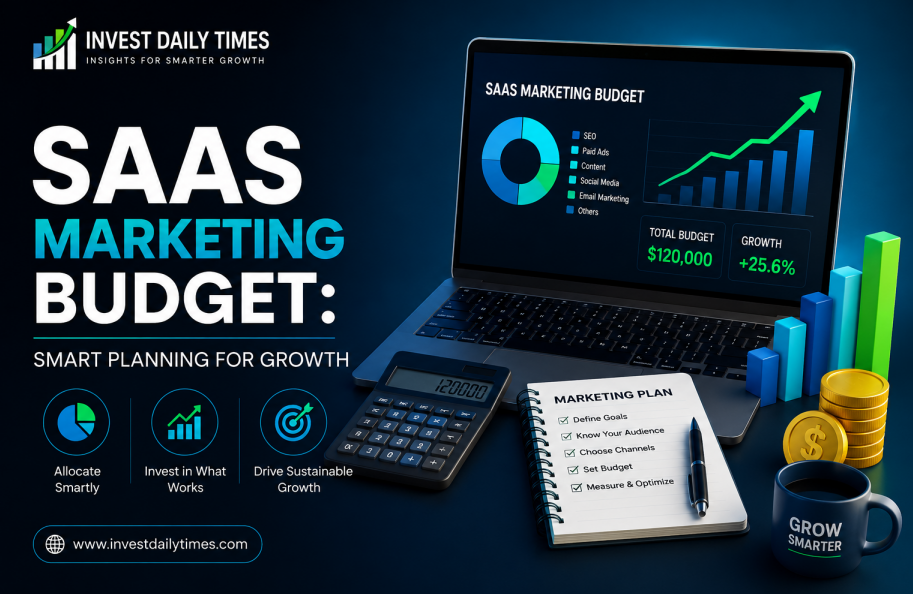
In a cutthroat subscription market, a SaaS marketing budget is more than simply a list of costs; it is a growth mechanism that regulates how quickly a business attracts, converts, and keeps clients. Recurring revenue models and subscription lifecycles create special financial planning requirements in the SaaS sector.
Businesses that carefully design their SaaS growth strategy can boost overall marketing performance, increase client acquisition efficiency, and accelerate growth. In competitive marketplaces, poor planning frequently results in inefficient scaling across paid and organic channels, wasted spend, and erroneous predictions.
Making wise budgetary choices has a direct impact on long-term performance, regardless of whether you are an established business growing internationally or a startup introducing your first product. A well-structured saas marketing budget aligns acquisition, retention, and brand-building efforts to ensure sustainable profitability, predictable revenue growth, and efficient resource allocation. This creates a scalable growth system built for highly competitive digital markets.
What Makes a SaaS Marketing Budget Different From Traditional Marketing Budgets?
Because SaaS companies rely on recurring revenue and long customer lifecycles, their marketing costs are different from typical marketing budgets. SaaS companies should take into account monthly recurring revenue (MRR), customer lifetime value (CLV), churn rate, and retention rather than just one-time sales. A SaaS company needs a budget that strikes a mix between acquisition and long-term engagement and renewal methods, whereas a traditional corporation can spend extensively to create instant transactions.
The rate of optimization is another significant distinction. SaaS businesses may swiftly modify campaigns since they have access to real-time data from digital platforms. A SaaS expansion strategy must therefore continue to be adaptable and performance-oriented. Based on real-time outcomes, funds are frequently transferred between paid search, content marketing, email automation, and product-led growth activities. Furthermore, SaaS companies often spend money on customer success, onboarding, and retention marketing—all of which are crucial for lowering attrition and increasing recurring income but receive less attention in traditional industries.
SaaS Marketing Budget Planning: Start With Revenue Goals, Not Expenses
Instead than beginning with a list of anticipated expenses, effective SaaS marketing budget planning starts with well-defined revenue goals. Setting a reasonable goal for monthly recurring revenue (MRR) or annual recurring revenue (ARR) based on your company’s stage, the state of the industry, and past performance is the first step. Once this goal has been set, you may work backward to determine how many clients, the average contract value, and the conversion rates are needed to achieve that growth level.
Examining tested frameworks that link revenue forecasts, budgeting, customer acquisition, and growth targets makes it much easier to understand how early-stage firms handle financial planning. Businesses seeking a deeper understanding of financial modeling for growing businesses can learn how founders align revenue projections, cash flow management, and growth objectives to build sustainable long-term success while making more informed budgeting decisions.
This method helps teams maintain alignment between spending choices, lead generation initiatives, and overall revenue strategy by ensuring that the SaaS marketing budget is constructed around quantifiable growth objectives rather than assumptions.
Many of the principles used in SaaS marketing budget planning also apply to broader financial management practices. Businesses seeking additional insights into budgeting, forecasting, and cost control can explore our budgeting category for related resources and planning strategies.
Building a SaaS Marketing Budget That Supports Rapid Scaling
The goal of a scalable SaaS marketing budget is to enable steady expansion without generating unsustainable client acquisition expenses or operational inefficiencies. Building systems and channels that can efficiently grow as demand rises is just as important as short-term performance. Long-term tactics like content marketing, SEO, referral programs, and marketing automation frequently produce compounding value over time, even while paid advertising might provide instant awareness and leads.
Prioritising a solid underlying infrastructure is crucial for increasing the effectiveness of all marketing operations when developing a scalable SaaS strategy. CRM systems, analytics tools, automation platforms, and customer success solutions that support performance monitoring and decision-making optimization fall under this category. Investing in qualified personnel is crucial in addition to tools since scalable growth depends on seasoned marketers, content strategists, and performance experts who can successfully carry out and optimize campaigns.
Additionally, a percentage for experimentation should always be included in a well-structured SaaS marketing budget. Companies can find high-performing possibilities early and adjust plans depending on actual market response by testing various channels, messaging, and campaign formats. This leads to more sustainable and data-driven growth over time.
SaaS Marketing Budget Benchmarks: What Top SaaS Companies Spend
Benchmarks for SaaS marketing budgets differ based on market competitiveness, product maturity, growth goals, and company stage. Because their main priorities are increasing awareness, gaining initial clients, and confirming product-market fit, early-stage SaaS businesses usually devote a bigger portion of their earnings to marketing. Businesses’ marketing expenditures as a percentage of sales frequently become more efficient and focused as they expand and build a stronger brand presence.
Common industry benchmarks generally fall within these ranges:
- Early-stage SaaS startups may spend 40–60% of revenue on marketing and sales because they need rapid customer acquisition and market validation.
- Growth-stage SaaS companies: around 20–40% of revenue
- Mature SaaS businesses: roughly 10–20% of revenue
- Enterprise SaaS companies: about 15–30% of revenue, depending on expansion and market conditions
Since actual spending fluctuates greatly depending on strategy and competitive pressure, these estimates should be viewed as guiding recommendations rather than set norms. Strong recurring revenue models may help high-growth SaaS companies purposefully sustain greater spending levels to speed customer acquisition. To guarantee long-term financial efficiency, however, sustainable budgeting choices are usually assessed using important performance measures such as customer lifetime value (LTV), customer acquisition cost (CAC), and payback period.
How to Allocate a SaaS Marketing Budget Across High-Impact Channels
Effective SaaS marketing budget allocation necessitates striking a balance between long-term growth channels and short-term acquisition. Businesses looking to improve spending efficiency and maximize ROI can benefit from proven marketing budget allocation strategies that help distribute resources across the most effective marketing channels. In highly competitive markets, successful companies rely on strategic customer acquisition cost planning to maximize profitability, scale faster, and ensure that every dollar invested contributes directly to sustainable revenue growth. Overinvesting in one channel, like paid advertisements, while ignoring content, retention, or brand development is a typical mistake that inhibits sustainable growth, lowers customer lifetime value, and severely restricts overall marketing efficiency over time.
A balanced SaaS marketing budget may include:
- Paid advertising (30–40%): Google Ads, LinkedIn Ads, retargeting, and social campaigns for immediate lead generation.
- Content marketing and SEO (20–30%): Blogs, guides, case studies, webinars, and organic search optimization for sustainable traffic growth.
- Marketing automation and email (10–15%): Lead nurturing, onboarding sequences, and retention campaigns.
- Product marketing and positioning (10–15%): Messaging, competitive analysis, and launch campaigns.
- Customer success and retention marketing (10–15%): Upselling, renewal campaigns, and user engagement initiatives.
- Experimentation and innovation (5–10%): Testing new platforms, partnerships, and growth tactics.
Your target market, product category, and overall business strategy will determine the best distribution. While product-led SaaS companies frequently prioritise SEO, free-trial optimisation, and in-product growth strategies to drive scalable user acquisition and conversion efficiently over time, B2B SaaS companies often allocate a larger share of their B2B marketing budget toward LinkedIn campaigns, account-based marketing, webinars, and other relationship-driven channels that help engage decision-makers throughout longer sales cycles.
The SaaS Marketing Budget Formula for Predictable Customer Acquisition
Businesses can plan customer acquisition more methodically and quantitatively with the use of a useful SaaS marketing budget formula. It makes budgeting more data-driven and predictable by directly linking growth goals with necessary investment.
Marketing Budget = Target Customers × Customer Acquisition Cost (CAC)
Divide the total marketing and sales expenditures by the number of new clients obtained within a certain time frame to get CAC. For instance, the CAC would be $500 per customer if a business spent $100,000 and gained 200 clients.
SaaS companies should also evaluate:
- CAC Payback Period: Time required to recover acquisition cost from customer revenue
- CLV:CAC Ratio: Customer lifetime value compared to acquisition cost (commonly analyzed for efficiency)
- Gross Margin: Determines how much budget can be reinvested into growth
- Churn Rate: Measures customer retention impact on long-term profitability
SaaS businesses can transform their marketing budget into an organised planning framework that facilitates forecasting, performance monitoring, and better growth decisions by combining these indicators.
Key SaaS Metrics That Should Influence Every Budget Decision
To achieve sustainable development and effective use of marketing spend, every SaaS growth strategy choice should be informed by data-driven metrics like CAC, LTV, churn rate, conversion rates, and payback duration.
The most important SaaS metrics include:
- Monthly Recurring Revenue (MRR): Tracks predictable monthly income.
- Annual Recurring Revenue (ARR): Measures long-term revenue growth.
- Customer Acquisition Cost (CAC): Evaluates acquisition efficiency.
- Customer Lifetime Value (CLV): Estimates total revenue generated per customer.
- Churn Rate: Indicates customer retention health.
- Lead-to-Customer Conversion Rate: Measures funnel effectiveness.
- Marketing Qualified Leads (MQLs) and Sales Qualified Leads (SQLs): Help assess lead quality and pipeline performance.
A powerful SaaS marketing budget is regularly adjusted depending on these metrics. For instance, increasing top-of-funnel advertising may not yield the same return on investment as investing more in customer success and retention if churn rises.
How Leading SaaS Brands Optimize Their Marketing Budget for Maximum ROI
Leading SaaS brands optimize their marketing budget by combining data analysis, automation, and continuous experimentation. They do not treat the budget as fixed; instead, they reallocate spending based on performance trends and customer behavior, often using tools such as Google Analytics to measure attribution, identify high-performing channels, and make more informed budget allocation decisions.
Common optimization strategies include:
- Using attribution modeling to identify the highest-converting channels.
- Automating lead nurturing and onboarding to reduce manual costs.
- Investing heavily in content that compounds over time, such as SEO and educational resources.
- Running A/B tests on ads, landing pages, pricing, and messaging.
- Focusing on retention and expansion revenue, which is often more cost-effective than acquiring new customers.
Businesses like HubSpot and Salesforce have shown the value of ecosystem-driven growth, customer education, and inbound marketing. Their success demonstrates that long-term client relationships, not just quick lead generation, should be given top priority in a SaaS marketing budget.
Hidden Costs Most SaaS Marketing Budgets Fail to Account For
Many SaaS marketing budgets overlook unstated expenses that have a big influence on profitability. Ignoring these costs can result in budget overruns, erroneous ROI estimates, forecast distortion, decreased cash flow efficiency, increased pressure on customer acquisition costs, and more challenging long-term scaling decisions for growth teams.
Common hidden costs include:
- Marketing technology subscriptions (CRM, analytics, automation, SEO tools)
- Creative production (video, design, copywriting, and branding)
- Website optimization and maintenance
- Sales enablement materials and training
- Customer onboarding and support resources
- Compliance, data privacy, and security requirements
- International expansion costs, including localization and regional advertising
Both direct campaign costs and the operating expenses necessary to sustain marketing performance should be included in a thorough SaaS marketing budget. This helps assure sustainable growth without unforeseen budget gaps, enhances the accuracy of financial planning, allows for better resource allocation across channels, and produces a more accurate view of overall investment and expected returns.
SaaS Marketing Budget Mistakes That Slow Down Growth
A SaaS marketing budget may fail to generate sustained development due to a number of typical errors. One significant error is concentrating just on lead volume rather than lead quality. In addition to lowering sales efficiency, raising churn risk, and eventually hurting total marketing ROI, producing a large number of low-quality leads may raise expenses without increasing revenue.
Other damaging mistakes include:
- Underinvesting in retention and customer success
- Relying too heavily on a single acquisition channel
- Failing to track attribution and ROI accurately
- Setting unrealistic growth expectations without supporting infrastructure
- Cutting marketing spend too aggressively during slower periods
- Ignoring experimentation and optimization opportunities
Balance is essential for a successful SaaS growth budget. To sustain healthy growth, enhance customer lifetime value, lower attrition, boost predictable revenue, improve positioning, and successfully attain scalable long-term profitability in competitive markets, businesses must simultaneously invest in acquisition, retention, brand building, and operational efficiency.
Real SaaS Marketing Budget Examples for Startups, SMBs, and Enterprises
As a business expands, a SaaS marketing budget’s structure changes dramatically. Mature businesses usually invest more in market leadership, expansion, and customer retention than startups do in client acquisition and brand awareness. Businesses may better allocate resources and steer clear of typical budgeting blunders by understanding how marketing objectives change at various stages of growth.
Startup SaaS Example
To speed up early growth, a firm with an annual recurring revenue (ARR) of about $200,000 might devote 40% to 60% of its income to marketing and sales initiatives. At this point, obtaining initial clients and confirming product-market fit are the main goals. A startup’s SaaS marketing budget typically gives priority to:
- Paid search and social media advertising
- Content marketing and SEO foundations
- Landing page and free-trial optimization
- Marketing automation and CRM tools
- Customer feedback and market research
Because startups need rapid learning and visibility, a larger percentage of revenue is typically invested in customer acquisition compared to more established companies.
SMB SaaS Example
A SaaS business that is expanding and has an annual revenue of about $2 million might allocate 20% to 30% of its income to marketing. At this point, scalable and predictable growth takes precedence over initial traction. Typical components of a SaaS marketing budget could be:
- Dedicated content marketing and SEO initiatives
- Webinar and email nurturing campaigns
- LinkedIn and search advertising
- Customer success and retention programs
- Advanced analytics and attribution platforms
The goal is to improve acquisition efficiency while increasing customer lifetime value and reducing churn.
Enterprise SaaS Example
Marketing typically accounts for 15% to 20% of sales for an enterprise SaaS company with an annual revenue of $50 million or more. Marketing initiatives become increasingly advanced and worldwide in scope. A well-developed SaaS marketing budget could help:
- Global brand awareness campaigns
- Account-Based Marketing (ABM) programs
- Industry conferences and strategic partnerships
- Multi-language content and regional marketing
- Customer expansion, retention, and loyalty initiatives
These illustrations demonstrate how a successful SaaS spending plan changes as the company expands and develops. Spending priorities gradually change from aggressive client acquisition to efficiency, retention, brand authority, and long-term profitability as businesses grow.
Future-Proofing Your SaaS Marketing Budget for Sustainable Growth
It takes more than just setting aside money for ongoing initiatives to make a SaaS marketing budget future-proof. It entails developing a scalable and adaptable financial plan that can adjust to shifting consumer demands, market conditions, and new technological advancements. Businesses must make sure that their marketing expenditures continue to be successful both now and in the years to come as the SaaS industry becomes more competitive.
Long-term growth drivers should be given equal priority with short-term acquisition attempts in a sustainable SaaS growth budget. Businesses that make investments in customer communities, content marketing, SEO, and brand authority frequently create stronger bases for steady expansion. Maintaining a variety of acquisition channels also lessens the chance of becoming overly dependent on one platform or source of traffic. Additionally, companies should use automation and data analytics to increase productivity, cut expenses, and make better budgetary choices.
Several strategies can help future-proof a SaaS Marketing Budget:
- Diversify acquisition channels to minimize risk.
- Invest in first-party data and customer insights.
- Strengthen organic growth through content and SEO.
- Automate repetitive marketing processes.
- Monitor CAC, churn rate, and customer lifetime value regularly.
- Reserve funds for testing, innovation, and unexpected opportunities.
A SaaS marketing budget that is prepared for the future is dynamic. It changes in response to market trends, business goals, and performance data. In an increasingly dynamic SaaS environment, companies that embrace strategic flexibility and continual optimisation are better positioned to achieve sustainable development, maximise marketing ROI, and maintain a competitive advantage.
FAQs
What is the appropriate marketing budget for a SaaS startup?
In order to speed growth and acquire market penetration, early-stage SaaS businesses frequently allocate 40–60% of their income to marketing and sales.
For SaaS, what is a healthy CLV:CAC ratio?
The customer lifetime value is three times the acquisition cost when the CLV:CAC ratio is 3:1, which is typically regarded as healthy.
For SaaS marketing, which channels typically yield the highest return on investment?
For SaaS enterprises, SEO, content marketing, email automation, referral programs, and targeted paid advertising frequently yield high return on investment.
How often should a SaaS marketing budget be reviewed?
Most SaaS companies review key performance metrics weekly and conduct a more comprehensive budget evaluation monthly or quarterly, depending on growth stage and campaign activity.
Does the SaaS marketing budget need to account for retention marketing?
Indeed. Reducing attrition, raising client lifetime value, and boosting total profitability all depend on retention marketing.
Conclusion
A SaaS marketing budget is a strategic framework that directs client acquisition, business expansion, and long-term profitability. It is far more than just a spending plan. SaaS organisations have to balance acquisition expenses with lifetime value, recurring revenue, and client retention, unlike traditional marketing budgets. Businesses can prioritise high-performing channels, manage resources efficiently, and make data-driven decisions that promote long-term growth with the aid of a well-thought-out SaaS scaling strategy.
Successful SaaS companies recognise that budgeting is a continuous process as opposed to a one-time event. Businesses can increase productivity and cut wasteful spending by establishing specific revenue targets, keeping an eye on important indicators like CAC, LTV, churn rate, and ROI, and consistently optimising marketing expenditures. Investing in both customer acquisition and retention maximises the value created from each customer relationship while guaranteeing steady development.
Businesses that maintain flexible and performance-focused budgeting practices will be better positioned to adjust to shifting market conditions and customer expectations as the SaaS industry develops. In an increasingly cutthroat digital industry, a wise SaaS marketing budget builds a solid basis for steady development, increased brand awareness, enhanced customer loyalty, and long-term business success.
To stay informed about SaaS marketing trends, smart budgeting strategies, customer acquisition best practices, and business growth insights, connect with Invest Daily Times on Facebook, Instagram, and Twitter.
Through Invest Daily Times, you get practical guidance, data-driven analysis, and actionable resources designed to help SaaS companies make smarter marketing decisions and build long-term, sustainable growth systems.











Leave a comment