


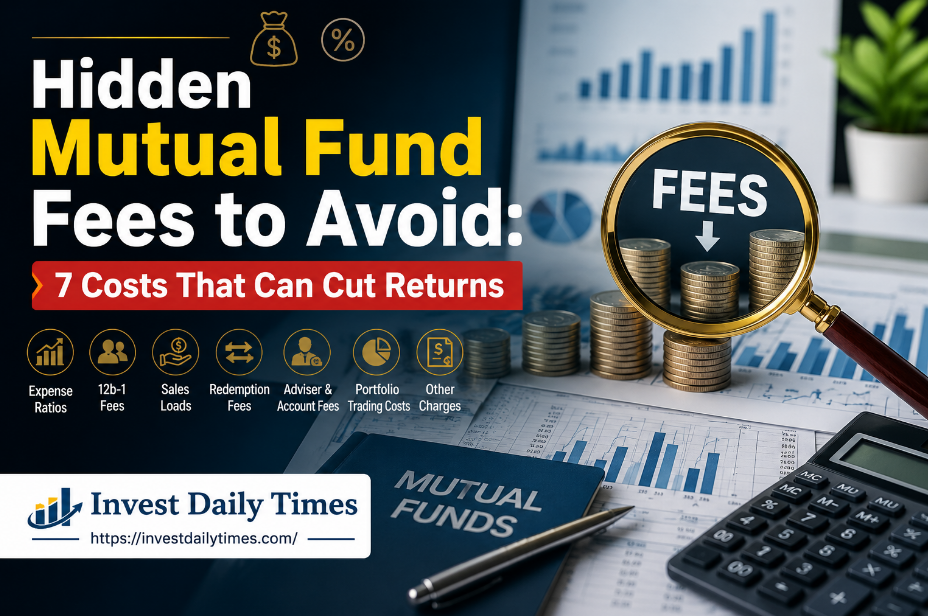
We are discussing today’s Hidden Mutual Fund Fees to avoid. Mutual Funds provide an easy method of developing a diversified portfolio without having to choose each stock or bond individually. However, diversification and professional management also entail expenditure, and the expenditure can impact the amount of your investment profits you end up retaining. The problem is that the existence of hidden mutual fund fees does not always imply their concealment in a legal sense.
The majority of the charges are revealed in a prospectus of a fund and other necessary documents. They may be ignored since some are deducted from fund assets, others are only charged on the occasion you sell or purchase shares and others are imposed by a broker, retirement plan or a financial advisor.
That distinction matters. The ratio of expenses is a significant figure, and it does not reveal the full cost picture. The Securities and Exchange Commission (SEC) divides the cost of mutual funds into operating expenses and shareholder fees per year. The operating expenses may be management fees, 12b-1 fees and other expenses, whereas the shareholder fees may be sales loads, purchase fees, redemption fees, exchange fees and some account fees. The environment of costs has also become competitive. The Investment Company Institute (ICI) reports that in 2025, the asset-weighted average expense ratio of U.S. equity mutual funds was 0.40% and mutual funds investing in bonds had a 0.36 average.
ICI also reported that average expense ratios of equity mutual funds decreased 62 per cent between 1996 and 2025 and bond mutual fund expense ratios decreased 57 per cent. It does not imply that all funds that cost higher than those averages are necessarily costly. Various strategies are associated with various costs.
Rather, these numbers offer valuable background information when making decisions as to whether fund fees are competitive with similar funds.
This guide examines hidden mutual fund fees to avoid, along with other fund-related costs that investors need to understand, how they work, and how investors can estimate the overall cost of investing.
What Are Hidden Mutual Fund Fees?
The term hidden mutual fund fees is typically used to refer to costs that are not taken into account or are misconstrued by investors, as opposed to costs that are imposed covertly. A prospectus of a fund has a standardised table of fees that disaggregates shareholder fees against annual fund operating costs. The expense ratio is the annual operating expenses of the fund as a percentage of its average net assets. Investors can also review the SEC’s investor guidance to better understand how these costs are disclosed.
To investors, the key difference is the manner in which the cost is passed on to them. It deducts some expenses from the assets of the fund, thus lowering the value of the fund and indirectly impacting the shareholders.
Other fees are paid when a shareholder sells, buys or trades shares. As an illustration, a financial adviser can collect an asset-based advisory fee or a brokerage or a retirement plan will collect different account-based fees.
One practical method of organising the mutual fund costs is:
- Continuing fund costs – recurrent costs charged against fund assets.
- Transaction and shareholder charges – the cost of purchasing, selling, or trading shares.
- Intermediary and account costs– fees billed separately by advisers, brokers or retirement plans.
- Portfolio transaction costs – fund costs involved in the purchase and sale of underlying securities by the fund.
These categories are more beneficial to understand than to consider an individual fee.
Why Mutual Fund Fees Matter Over the Long Term
A recurring fee not only lowers your current payment. The money spent on investments is no longer available to generate returns in the future.
Take a simplified case. Assume an investor starts with a $100,000 investment and earns a hypothetical 6% annual return before expenses over 20 years.
When the annual costs of one investment are 0.20 per cent, and the annual costs of another investment are 1.20 per cent, the difference is one percentage point per year.
That does not imply that the investor will just pay an extra 1% per annum. The increased cost also reduces the capital available to compound.
Both the SEC and FINRA stress that apparently minor disparities in investment costs may make a considerable difference in the long run. FINRA’s Fund Analyzer is designed to demonstrate how fees and expenses can affect investment value over time.
That is why comparing costs is especially important when two funds have similar investment goals. The objective should not, however, be to always select the lowest-cost fund.
An investment strategy, asset exposure, research process, or service that an investor values could be offered by a higher-cost fund. The more important question is:
Will the extra cost be justified by what the fund offers relative to similar options?
1. 12b-1 Fees: An Ongoing Distribution Cost
A 12b-1 fee is a recurrent fee charged on mutual-fund assets pursuant to a suitable Rule 12b-1 plan.
These fees may also pay some distribution costs, including marketing and selling fund shares, and some shareholder services.
According to Investor.gov, 12b-1 fees are usually imposed on mutual funds as opposed to ETFs.
Since the charge is paid out of fund assets, investors are not usually given an independent bill. Rather, the fee is included in the operating expenses of the fund.
How Much Can 12b-1 Fees Be?
It is here that generic explanations may be misleading.
Under FINRA Rule 2341, an asset-based sales charge may not exceed 0.75% per year, while a service fee may not exceed 0.25% per year, subject to the rule’s applicable requirements.
These are regulatory thresholds to the sales-charge regime of FINRA, not the regular 12b-1 fee imposed by all mutual funds.
They are not the 12b-1 standard fee imposed by all mutual funds but regulatory limits. These numbers are not to be understood as meaning that all mutual funds are 12b-1 fee of 1%.
These are control parameters within the relevant sales-charge framework, rather than standard charges.
The actual cost paid to a given fund is likely to be significantly less-or even no cost. Investors ought to consult the current prospectus of the fund instead of thinking a specific 12b-1 percentage is applicable.
Why Should Investors Pay Attention?
Assume that there are two funds with significantly similar investment objectives and one has a greater ongoing distribution cost.
That extra cost is another obstacle that the more expensive fund must also surmount before an investor can earn the same net payoff.
The reason to reject a fund does not necessarily involve a 12b-1 fee. However, when there are similar alternatives with similar exposure at a reduced ongoing cost, the difference is worth consideration.
2. Sales Loads: Front-End and Deferred Charges
Sales loads are some of the simplest types of costs of mutual funds since they may be directly applied when buying mutual funds or redeeming them.
The purchase of shares is billed as a front-end sales load. A deferred sales load, commonly in the form of a contingent deferred sales charge (CDSC), is typically paid upon your redemption of shares and can decrease with the length of holding the shares.
The particular plan is presented in the prospectus of the fund.
Front-End Loads
Assume a hypothetical 5% front-end loaded investment of 10,000 $.
Should the load be determined as 5% of the price of the public offering, the investor would have had about 9,500 invested, less the charge. It implies that less capital starts working for the investor. Breakpoint discounts are offered by some funds and can lower the sales charge on eligible investments.
The rules of FINRA deal with the issues of quantity breaks and eligibility for accumulation, and therefore investors ought to establish whether their investment is eligible for a lower fee.
Deferred Sales Charges
A deferred load transfers the cost on the date of purchase to a subsequent redemption.
An example is when a fund implements a CDSC when shares are sold during a given time. The holding period can decrease the percentage.
This can cause the initial acquisition to seem cheaper than a front-loaded one, although the investor can incur a fee when selling out.
Is 8.5% the Standard Maximum?
No.
No. According to FINRA Rule 2341, the total front-end and deferred sales charges imposed by some open-end investment firms where there is no asset-based sales charge may not exceed 8.5% of the offering price.
The regulation also offers reduced maximums in some situations, such as the situations whereby rights of accumulation or certain quantity discounts are not made available.
So it would be erroneous to say: Mutual funds typically charge as much as 8.5%.
The true meaning is that 8.5 % is an overlay limit on particular circumstances, and not a typical or anticipated sales load on mutual funds.
3. High Expense Ratios: The Cost You Pay Year After Year
The expense ratio is one of the most important numbers to examine when researching a mutual fund.
It is the yearly operating costs of the fund in relation to its average net assets. Such expenses may consist of management fees, 12b-1 fees and other operating expenses.
These costs may cover management fees, 12b-1 fees, and other operating costs. Investors do not usually pay the expense ratio in a separate transaction as they would a sales load.
These expenses are paid out of the fund’s assets and leave less value to shareholders.
What Is a High Expense Ratio?
- No percentage alone renders a mutual fund to be expensive. The reasonable rate of expenses is based on:
- Investment strategy
- Asset class
- Active or index management
- Geographic exposure
- Portfolio complexity
- Fund size
- Distribution structure
- Comparable funds
Nevertheless, industry data provides investors with a useful benchmark. ICI reported that in 2025:
- Assets in equity mutual funds had a weighted average of 0.40% as the expense ratio.
- Bond mutual funds had an average of 0.36%;
- Money market funds had an average of 0.24%.
To compare, ICI had average expense ratios of 0.14% in index equity ETFs and 0.09% in index bond ETFs.
These are guidelines and not suggested thresholds. The costs of an actively managed international fund and a broad-market index fund cannot necessarily be the same.
The Better Question
Instead of asking: “Is 0.80% high?”
Ask:
How does 0.80 per cent compare to other funds that offer a significantly similar exposure?
The above comparison offers more helpful information.
4. Redemption and Exchange Fees
Costs like those that emerge when investors withdraw money from a fund are given little attention by some mutual-fund investors.
When selling shares, a redemption fee might be paid, especially when they are redeemed soon after they are purchased.
According to SEC rule 22c-2(a), a registered open-end investment company may charge a redemption fee of as much as 2% on shares redeemed within seven calendar days after purchase, as required by the rule.
The rule does not imply that all mutual funds will have a fee of 2%.
The regulation does not imply that all mutual funds are going to charge a 2% fee. Such a charge can be imposed or not, depending on the requirements of the relevant fund.
Redemption Fee vs. Deferred Sales Load
These are not to be mixed up.
The fund receives a redemption fee, which can be structured in such a way that short-term trading is discouraged.
By comparison, a deferred sales load is a sales charge that may be imposed in case of redeeming shares, and is typically related to the sales compensation structure of the fund. These costs are differentiated by investor.gov in its mutual-fund fees advice.
Exchange Fees
There are also fund families that might impose an exchange fee when an investor transfers funds between two funds within the same family. Check before changing investments:
- Redemption restrictions
- Redemption fees
- Exchange fees
- Deferred sales charges
- Tax consequences
The last is not a fund fee, but it is important in determining the actual cost of investing in an investment in a taxable account.
5. Portfolio Trading Costs: Expenses Outside the Headline Ratio
The most widely misconceived aspect of mutual-fund costs is portfolio trading. A fund incurs expenses by purchasing and selling the securities in the fund.
These may be brokerage fees, bid-ask spreads and market-impact fees.
An increase in the turnover may reflect an increase in trading, but turnover cannot be a direct measure of transaction costs.
Investor.gov particularly indicates that the buying and selling of underlying securities may have transaction costs as other expenses diminishing the value of investments.
Why Portfolio Turnover Matters
Portfolio turnover rate is an indication of the number of times a fund changes the portfolio within a fiscal year.
Indicatively, a 100% turnover rate indicates that the turnover of the fund was equal to the average net assets of the fund during the period in question.
It does not imply that all the securities were literally changed once. Increased turnover may be a good indicator of increased trading activity, but turnover should not be regarded as a direct measure of transaction costs.
A fund which trades in securities that are relatively liquid could have low trading expenses even though the turnover is high.
A fund with lower turnover could still face relatively high trading costs if it trades less-liquid securities. Portfolio turnover, therefore, should be employed as an indicator of what to explore more, and not as a charge.
Why This Is Important for Active Funds
Trading may be an essential part of an active investment strategy.
It is not whether a manager is a frequent trader or not.
The question is whether the potential benefits of the strategy should be considered worth the overall costs of its implementation.
6. Financial Adviser, Brokerage and Account-Level Fees
Not within the mutual fund, there are other sources of hidden mutual fund fees.
A customer can pay individual fees to a financial advisor, brokerage firm, retirement plan or any other intermediary.
As an example, the potential expenses may be:
- Asset-based advisory fees
- Brokerage account fees
- Account maintenance charges
- Retirement-plan expenses
- Transfer fees
- Certain transaction charges
- Wrap-account fees
- Other intermediary costs
The prospectus fees table of a fund is not always a complete list of fees that an investor might pay beyond the fund, including some advisor fees, brokerage fees or account fees.
Advisory Fees Can Add Another Layer
Suppose a hypothetical investor owns a 500,000$ portfolio and pays 1% of the portfolio every year as an advisory fee.
That is 5,000$. Before portfolio performance or account value.
When the portfolio itself has mutual funds with their own expense ratios, the investor is paying two layers of expenses.
This does not necessarily render professional advice to be a bad value. Benefits can be offered by financial planning, portfolio management, tax coordination and other services. But the investor must know precisely what he is paying and what service he is receiving.
7. Purchase Fees and Other Shareholder Charges
Some of the charges imposed by a mutual fund to shareholders are not readily apparent since they are not counted in the annual expense ratio.
These may include:
- Purchase fees
- Exchange fees
- Redemption fees
- Account maintenance fees
- Sales loads
Investor.gov lists these sorts of charges as shareholder-fee information that investors should consider in the prospectus of a fund.
No-Load Does Not Mean No-Cost
This is one of the most important points for new investors.
This is among the most essential aspects for new investors. No-load mutual funds do not impose a sales load, but may include other charges, such as purchase fees, redemption fees, exchange fees, account fees, and operating expenses.
This does not imply that the investment is free of charge. Even in a no-load fund, it is possible to have:
- An expense ratio
- Management fees
- 12b-1 fees (where applicable).
- Redemption fees
- Exchange fees
- Purchase fees
- Account-level costs
- Other operating expenses
Particularly, Investor.gov states that even no-load share classes may have operating costs and other fees that may be incurred. No-load should therefore be considered as one quality of the fee structure of a fund, as opposed to being evidence that the investment has zero costs.
How to Find Mutual Fund Fees Before You Invest
The current prospectus of the fund is the most reliable place to start.
Investor.gov states that mutual funds will give a standardised fee table that indicates shareholder fees and the annual fund operating costs.
Look at these before investing.
1. Total Annual Fund Operating Expenses
This is the expense ratio of this fund.
2. Management Fee
Ask the investment adviser how much he or she charges to manage the portfolio.
3. 12b-1 Fee
Identify the presence of fund charges in the form of distribution or service fees to shareholders.
4. Other Expenses
Check administrative, legal, accounting, custody, transfer-agent and other costs.
5. Sales Charges
Look for front-end and deferred sales loads.
6. Redemption and Exchange Fees
Know whether selling or trading shares can result in extra fees.
7. Share Classes
Should the fund have several share classes, evaluate their entire cost structure.
The cheapest initial cost does not imply the cheapest cost in the longer holding period. Investor.gov particularly cautions investors not to merely pick the share class with the lowest initial charge but rather the total cost of the various classes.
8. External Account Costs
Lastly, review your retirement-plan documents or advisory agreement, brokerage agreement.
The prospectus of the fund will not inform you about all the costs charged by your investment intermediary.

How to Compare the Total Cost of Two Mutual Funds
Suppose there are two funds with similar investment objectives.
Rather than comparing their expense ratios alone, create a larger cost comparison:
| Cost Factor | Fund A | Fund B |
| Expense ratio | Check prospectus | Check prospectus |
| Management fee | Compare | Compare |
| 12b-1 fee | Check | Check |
| Front-end load | Check | Check |
| Deferred sales load | Check | Check |
| Redemption fee | Check | Check |
| Exchange fee | Check | Check |
| Purchase fee | Check | Check |
| Portfolio turnover | Review | Review |
| Account/intermediary cost | Check | Check |
| Investment strategy | Compare | Compare |
Next, go beyond fees.
Compare:
- Investment objective
- Benchmark
- Asset allocation
- Risk level
- Diversification
- Investment strategy
- After-expenses historical performance
- Tax considerations
- Portfolio construction
- Expected holding period
This helps to avoid a typical error that the fund with the lowest expense ratio is necessarily the better investment.
The cheaper alternative can actually be more favourable when the funds offer a comparable exposure and services; however, the cost is only one aspect of the investment decision, not the whole decision.
What the 2025 Mutual Fund Fee Data Tells Investors
The latest ICI data provides useful context for anyone evaluating fund expenses in 2026.
For 2025, ICI reported:
| Fund Type | 2025 Asset-Weighted Average Expense Ratio |
| Equity mutual funds | 0.40% |
| Bond mutual funds | 0.36% |
| Money market funds | 0.24% |
| Index equity ETFs | 0.14% |
| Index bond ETFs | 0.09% |
According to ICI, the average equity mutual-fund expense ratio has fallen 62% from 1996 to 2025, and the average bond mutual-fund expense ratio has fallen 57%.
The fall is a general trend towards cheaper investment products and greater competition.
ICI reported that in 2025, 92% of gross sales of long-term mutual funds went to no-load funds without 12b-1 fees, compared with 46% in 2000.
This presents a valuable investor lesson:
A disclosed fee is not always a competitive fee.
You must not judge a fee to be reasonable just because it is displayed in the prospectus with other similar funds, but you must compare it with other similar funds.
7 Practical Ways to Avoid Unnecessary Mutual Fund Fees
It is half the battle to know the charges. The second thing is to apply that information in making comparisons of investments.
1. Compare Funds with Similar Objectives
Don’t equate an actively managed emerging-markets fund to a broad U.S. index fund simply because it has a lower expense ratio.
Comparisons of costs are more useful when the funds are similarly exposed.
2. Check Every Available Share Class
A fund can have multiple classes of shares with varying loads and ongoing costs.
The lowest-cost share class initially might not be the lowest-cost share class in total cost during your anticipated holding period.
3. Investigate 12b-1 Fees
When two similar funds are similar in strategy, but one imposes a continuing 12b-1 fee, then ask the question of whether there is some incremental service or distribution that warrants the expense.
4. Do Not Treat “No-Load” as “Free”
In this case, always check the full fee table.
No-load funds need not be free of operating expenses and other shareholder or account-level expenses.
5. Avoid Unnecessary Switching
Before selling or trading a fund, look out for redemption fees, exchange charges, deferred sales loads and possible tax implications.
Changing frequently may incur expenses even though it may not add value to your portfolio.
6. Calculate the Complete Cost
Think beyond:
Expense ratio
and consider:
Operating expenses of the fund + shareholders’ expenses + account/advisor fees + portfolio transaction costs.
All components will not be expressed as a single percentage, but the view of the whole structure gives a more realistic view.
7. Use Official Investor Tools
The resources of the SEC and FINRA allow investors to check information rather than fully relying on third-party ratings and fund summaries.
FINRA’s comparison tool can help research investments and determine how fees, expenses, discounts, holding periods and other assumptions may impact their value over time.
Investors may also use the tool to compare share classes and possible breakpoint discounts.
Mutual Fund Fee Checklist
Before buying a mutual fund, make sure you can answer these questions:
- What is the present ratio of expenses?
- What is the management fee?
- Is there a 12b-1 fee on the fund?
- What are the other operating costs?
- Does it have a front-end sales load?
- Is there a deferred sales charge?
- Do we have breakpoint discounts?
- Is there any redemption fee incurred by the fund?
- Is an exchange fee charged?
- Does it have a purchase charge?
- Is the fund multi-class?
- What share class would be the most economical in my case?
- What is the rate of portfolio turnover?
- What are some of the extra expenses of trading underlying securities?
- Is my brokerage fee account-based?
- Do I pay a separate advisor?
- Comparison with similar alternatives?
- Did I check out the existing prospectus?
- Have I checked the latest shareholder report?
You may not be able to answer all those questions, but that does not necessarily imply that the fund is not a good investment.
It just implies that you need to acquire more information prior to making a decision.
FAQs
What are the main hidden mutual fund fees to avoid?
High expense ratios, 12b-1 fees, sales loads, redemption or exchange fees, purchase charges, portfolio transaction costs and separate adviser or account fees are the costs that warrant the most attention.
Not all fees are preventable, and the more expensive funds may offer a strategy or service which is worth paying. The aim is to find unneeded or uncompetitive expenses.
Are mutual fund fees actually hidden?
Usually, no.
The majority of mutual fund fees are reported in documents which are required. The issue is that there are expenses that are deducted from fund assets, and there are those that are charged only in specific situations or charged by the intermediaries that are not part of the fund.
This is why they can be disregarded by investors even in cases when the information is technically available.
What is a 12b-1 fee?
A 12b-1 fee is a fee that is paid by mutual fund assets pursuant to a Rule 12b-1 plan to pay some distribution costs and, in some instances, shareholder services.
Is a 1% 12b-1 fee normal?
No.
A 1% value cannot be termed a normal 12b-1 fee.
The structure of FINRA has a 0.75 % limit on the asset-based sales charges and a limit of 0.25% on the service fees, but is subject to the relevant rules.
These are not standard fees that are paid by all funds but regulatory limits.
Is 8.5% the normal maximum mutual fund sales load?
No.
The FINRA Rule 2341 has set an 8.5% limit on the aggregate front-end and deferred sales charges, subject to the conditions of the rule.
Other circumstances may lead to reduced limits being applied.
Hence, 8.5% must be introduced as a regulatory ceiling given certain circumstances, not as the average rate that investors ought to be charged.
Are no-load mutual funds free?
No.
No-load usually implies that the fund is not required to have a sales load. It may still be subject to an expense ratio, management expenses, 12b-1 fees where applicable, redemption fees, exchange fees, purchase fees or other fees.
What is a reasonable mutual fund expense ratio?
No universal number.
Both ICI and other U.S. industry averages indicated that ICI recorded an asset-weighted average expense ratio of 0.40% of equity mutual funds and 0.36% of bond mutual funds as a benchmark in 2025.
A more appropriate comparison is between the funds that share similar investment goals, strategies and risk profiles.
Are trading costs included in the expense ratio?
Not necessarily.
The fund may have transaction costs that are not included in the expense ratio of the fund that are attributed to the purchase and sale of the securities owned by the fund.
That is one of the reasons why portfolio turnover and investment strategy should also be considered regarding the headline expense ratio.
Where can I find a mutual fund’s fees?
Begin with the prospectus and standardised fee table of the fund in existence.
You may also read shareholder reports and SEC and FINRA investor materials. A Fund Analyser provided by FINRA can be used to compare the approximate impact of fees and other costs between funds and share classes.
Conclusion
The greatest point to note about the hidden mutual fund fees to avoid is that hidden normally refers to the fact that it is not secretly charged or hidden; rather, it is ignored.
The expense ratio of a mutual fund will be a starting point, but it will not be the only component of the cost equation. Investors also need to look at 12b-1 fees, sales loads, redemption and exchange fees, purchase fees, portfolio trading fees and any separate fees that an adviser, broker or retirement plan imposes.
The existing pricing landscape provides investors with additional chances to compare prices. According to the 2025 data by ICI, the average expense ratio of mutual funds of both equities and bonds is still comparatively low in historical terms, with equity and bond mutual funds having average ratios of 0.40 and 0.36, respectively, on an asset-weighted basis. Yet not all funds have an industry average as a target. It is better to compare similar investments in terms of total cost basis.
An expensive fund may be worthwhile when its plan or services are valuable enough, whereas an unnecessarily expensive fund may cause an effective drag on long-run performance.
Before investing, read the existing prospectus, compare existing share classes, verify shareholder charges, know the fees of your intermediary, and use tools like the FINRA Fund Analyser when suitable.
The goal is not to eliminate every investment cost. It is to understand what you are paying, determine whether the cost is competitive, and decide whether the fee is justified by the investment or service you receive. The cost of mutual funds often flies under the radar and may quietly influence returns over the long term.
At Invest Daily Times, we turn complex investing costs into clear, practical insights, helping readers identify overlooked fees, compare alternatives, and make more informed investment decisions. Follow Invest Daily Times on Facebook, Instagram, and Twitter for more investing and market insights.
Investment Disclaimer: The article is educational and informational only and is not financial, investment, tax or legal advice. Mutual funds are risky and have the potential to lose the principal. Regulatory requirements, fund policies and fees may vary and therefore investors ought to check the existing fund documents and to take into consideration their personal situations before making an investment decision.












Leave a comment