


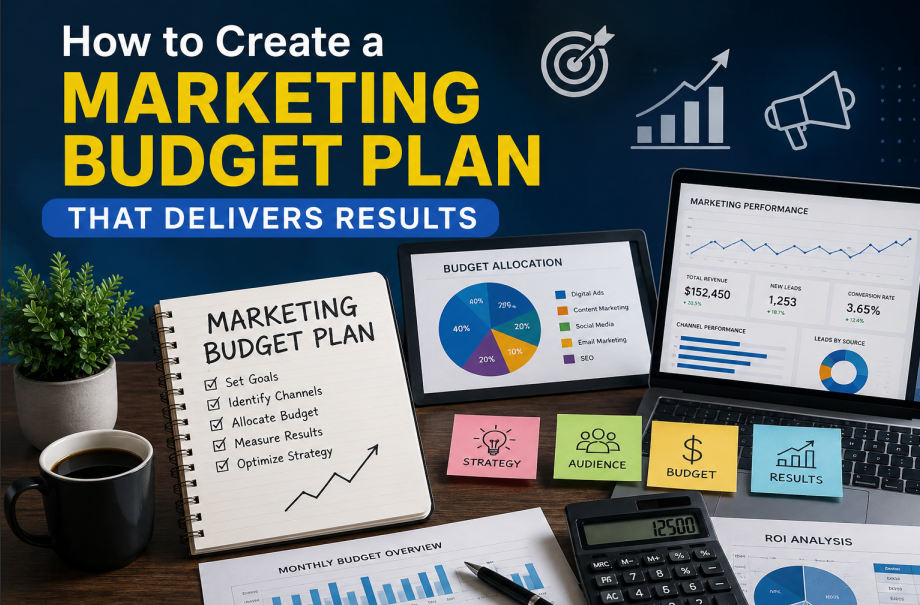
One of the most important tools a company can employ to ensure steady growth is a marketing budget plan. Many businesses spend money on marketing initiatives without knowing exactly how much, where, or what kind of returns to anticipate. This frequently results in wasted resources and unsatisfactory results. By assisting companies in effectively allocating funds across a range of marketing projects, a well-structured marketing budget plan offers direction.
Search engine optimization, content marketing, email campaigns, social media advertising, influencer alliances, and paid search advertising are just a few of the many channels used in modern marketing. Investment is necessary for each of these channels, and it becomes challenging to identify which initiatives are producing value in the absence of appropriate funding. A budget acts as a guide to match marketing expenditures with corporate goals.
According to HubSpot, businesses that take a strategic approach to budgeting are often better positioned to monitor campaign performance, allocate resources effectively, and make data-driven marketing decisions.
Furthermore, a solid Marketing Financial Plan fosters accountability. Teams are able to assess performance, compare results to objectives, and make required adjustments. Businesses that carefully manage their marketing expenditures are often in a stronger position to achieve sustainable growth in competitive markets. Companies looking to strengthen their financial decision-making can also explore the budgeting resources available on Invest Daily Times, where they can find practical budgeting strategies, expense management tips, and financial planning guidance designed to improve spending efficiency and support long-term business growth.
Understanding the Fundamentals of an Effective Marketing Budget Strategy
A marketing budget plan is a financial framework that outlines how much a business intends to invest in marketing activities during a specific period. Advertising, content creation, social media administration, software subscriptions, branding campaigns, market research, and analytics tools are a few examples of these activities. The budget’s goal is to support business growth objectives and make sure resources are allocated efficiently.
A common misconception among businesses is that marketing budgets are just spending reports. In actuality, a Marketing Financial Plan serves as a strategic document that aids businesses in setting priorities and managing expenditures. Businesses can track expenses and determine which projects yield the best outcomes by allocating specified amounts to various operations.
Short-term and long-term goals should be balanced in an efficient budget. While certain efforts, like content marketing and search engine optimisation, can take months to provide noticeable returns, others, like paid advertising, might produce leads right away. Proper planning requires an understanding of this distinction.
Flexibility is another essential component of a marketing budget plan. Unexpected possibilities appear, markets shift, and consumer behaviour changes. Businesses that allow for flexibility are better equipped to adapt to changing conditions. Businesses can strengthen their basis for long-term marketing success and more intelligent financial management by grasping these principles.
Prior to creating a marketing budget plan, establish clear business objectives.
Every effective marketing budget plan starts with well-defined corporate objectives. It becomes challenging to decide how to measure performance or allocate resources in the absence of objectives. Instead of existing on their own, marketing initiatives should constantly serve more general organisational aims.
For instance, a business aiming to raise brand awareness would devote more of its resources to public relations, social media initiatives, and content marketing. Conversely, a company looking for quick revenue development would give paid advertising, lead generation, and conversion optimisation tactics top priority.
Businesses should take into account the following before developing a marketing budget plan:
- Set quantifiable marketing goals.
- Sync marketing objectives with overarching business aspirations.
- Set attainable deadlines for completion.
- Determine the KPIs (key performance indicators).
- Decide on the metrics for success.
Because they give budget allocation direction, well-defined goals facilitate better decision-making. By enabling companies to assess performance impartially, they also foster accountability. It is simpler to defend spending and spot areas for improvement when marketing expenditures are directly linked to business results.
Businesses can avoid making reactive decisions by using a goal-driven marketing budget plan. Organisations can concentrate on initiatives that directly promote growth rather than allocating resources based on presumptions or trends. This methodical approach boosts productivity and raises the possibility of attaining significant outcomes.
How to Develop a Marketing Budget Plan Depending on Industry and Business Size
Since no two organisations are exactly the same, each marketing budget plan should be customised to fit specific business needs. Budgeting decisions are influenced by a number of variables, including firm size, industry competitiveness, customer acquisition expenses, and growth ambitions. A local business or startup may not benefit from a strategy that works for a worldwide corporation.
Due to their limited resources, small firms must concentrate on high-impact marketing initiatives. Cost-effective strategies including content marketing, email marketing, SEO, and local advertising are usually given priority in their budgets. Because creating exposure is crucial in the early phases of growth, startups could allocate a higher portion of their revenue to marketing.
Budgeting decisions are also impacted by industry conditions. In comparison to industries with lower client acquisition costs, highly competitive areas like technology, finance, and e-commerce can require bigger marketing investments. While keeping in mind that averages are merely recommendations, businesses should investigate industry benchmarks.
Instead of just imitating rival spending, an effective marketing budget plan should represent organisational objectives. Before making decisions, businesses should assess market potential, review past performance, and take available resources into account.
In the end, the best budget is one that matches expenditures with reasonable development goals. Organisations can develop budgets that promote sustainable growth while preserving financial stability by comprehending how industry conditions and firm size affect marketing needs.
Choosing the Appropriate Marketing Channels for Your Marketing Spending Plan
One of the most crucial elements of an effective marketing budget plan is selecting the appropriate marketing channels. Each channel has its own expenses, benefits, and audience prospects. Businesses must determine where their target audience spends time and how they make purchases because it is rarely feasible to invest in every channel offered.
Search engine optimisation, social media marketing, content marketing, email campaigns, sponsored advertising, influencer collaborations, and video marketing are examples of common marketing channels. Every channel has a distinct function and makes a unique contribution to corporate goals.
When assessing marketing channels, companies ought to take into account:
- Audience’s characteristics and habits.
- Expenses associated with acquiring customers.
- Possible yield on investment.
- Resources and knowledge are available.
- Enduring sustainability.
A balanced marketing budget strategy typically combines multiple marketing channels to achieve both short-term and long-term objectives. While SEO and content marketing support long-term visibility, paid advertising can produce visitors right now. Social media increases company recognition and engagement, while email marketing may help retain customers.
Companies should assess channel performance on a regular basis and modify spending as necessary. While underperforming tactics should be improved or removed, channels that regularly produce excellent results might be worthy of more funding.
Choosing the appropriate channels guarantees that resources are allocated where they will have the biggest impact and helps optimise the efficacy of a marketing budget plan.
Effective Fund Allocation in Your Marketing Budget Plan
Since it dictates how resources are allocated among marketing activities, fund allocation is an essential component of any Marketing Spending Plan. If money is spent inefficiently, even companies with large budgets may face difficulties. Balancing tried-and-true tactics with chances for development and experimentation is necessary for effective allocation.
Establishing essential marketing operations, such as advertising, content production, analytics, technology, and team resources, should be the first step for organisations. The activities that yield the highest returns and merit more investment can be identified with the use of historical performance data.
Generally, a balanced marketing budget plan consists of:
- Primary marketing initiatives.
- Initiatives to develop a brand.
- Programmes for retaining customers.
- Costs for software and technology.
- Budgets for innovation and testing.
Allocating too much of the budget to a single channel is a common mistake that can limit overall marketing effectiveness. Diversification lowers risk and offers chances to find fresh approaches to expansion. Relying too much on one platform might expose firms to unforeseen challenges because markets are subject to rapid change.
Additionally, companies should set aside a percentage of their budget for unanticipated opportunities. Emerging technologies, market developments, or new advertising platforms may offer benefits that were not foreseen during initial planning.
Allocating funds strategically allows businesses to maximise outcomes while preserving flexibility. Organisations can increase the efficacy of their marketing budget plan and attain better long-term results by allocating resources carefully and routinely evaluating performance.
How to Determine Your Marketing Budget Plan’s ROI
Determining whether a marketing budget plan is yielding significant outcomes requires measuring return on investment. ROI assists companies in determining which marketing initiatives are worthwhile and which need to be modified. Without measurement, businesses run the danger of investing funds without understanding if their efforts are successful.
The fundamental ROI calculation contrasts the entire cost of marketing initiatives with the income they generate. However, additional indicators like customer acquisition cost, conversion rates, lead quality, and customer lifetime value are frequently included in contemporary marketing analysis.
Companies can enhance ROI tracking by:
- Establishing precise performance standards.
- Keeping a continuous eye on campaign performance.
- Monitoring consumer trips.
- Evaluating both immediate and long-term results.
- Using trustworthy analytics software.
Platforms such as Google Analytics help businesses track traffic sources, user behavior, conversion performance, and overall campaign effectiveness. These insights help marketers identify opportunities for optimization.
Continuous measurement, as opposed to one-time assessments, is essential to the success of a Marketing Budget Strategy. Certain initiatives, including brand awareness campaigns, may have long-term advantages that are not immediately apparent through direct revenue measurements.
Businesses can increase productivity, save waste, and get the most out of every marketing dollar spent by regularly evaluating ROI and adopting data-driven changes.
Typical Errors to Avoid in Marketing Budget Planning
By committing preventable budgetary errors, many firms jeopardise their success. Missed opportunities, uneven performance, and resource waste are all possible outcomes of a poorly established marketing budget plan. Organisations can develop more robust and successful strategies by being aware of typical mistakes.
Setting unreasonable expectations is a common error. Rarely do marketing expenditures yield instantaneous returns across all platforms. Companies that anticipate rapid success may give up on long-term, successful strategy too soon.
Other typical errors consist of:
- Failing to establish quantifiable objectives.
- Disregarding past performance information.
- Putting too much money into one marketing channel.
- Ignoring consumer insights.
- Avoiding routine evaluations of performance.
Inadequate tracking is another problem. Businesses are unable to identify the actions that lead to growth without precise measurement. Inefficient expenditure is frequently the result of decisions made based on conjecture rather than facts.
Additionally, some organisations neglect to set aside funds for innovation and testing. Experimentation can reveal fresh chances that enhance performance, even while tried-and-true tactics should be supported.
Flexibility, accountability, and ongoing assessment are necessary for a Marketing Budget Strategy to be effective. Businesses can enhance resource allocation, bolster marketing efficacy, and attain superior long-term outcomes by avoiding these typical blunders.
Software and Tools for Managing Your Marketing Budget Plan
In order to manage a current marketing budget plan, technology is essential. Businesses want technologies that enhance visibility, reporting, and decision-making as marketing operations become increasingly complicated. The appropriate software may make managing a budget easier and offer insightful information about the effectiveness of campaigns.
Businesses frequently utilise:
- Software for tracking budgets.
- Platforms for marketing analytics.
- Tools for project management.
- Systems for managing customer relationships.
- Dashboard and reporting solutions.
These technologies assist companies in tracking outcomes, keeping an eye on expenditures, and seeing areas for improvement. Marketing teams can concentrate on strategy and execution thanks to automation capabilities that lessen administrative work.
The American Marketing Association offers helpful tools and information about budgeting and marketing strategy. Businesses may stay up to date on industry changes and best practices by using educational resources.
Transparency and accountability are enhanced by efficient software implementation. Real-time data is made available to teams, facilitating improved performance analysis and decision-making.
Organisations may increase reporting accuracy, optimise the return on marketing spending, and streamline operations by integrating technology into their marketing budget plan.
Modifying Your Marketing Budget Strategy to Improve Results
A marketing budget plan should never stay the same. Over time, there can be substantial changes in customer behaviour, market conditions, competition, and business objectives. Businesses that evaluate and modify their budgets on a regular basis are frequently in a better position to take advantage of opportunities and deal with difficulties.
Budget modifications should be guided by performance analysis. Metrics including revenue contribution, client acquisition expenses, engagement levels, and conversion rates should be assessed by businesses. While underperforming projects should be optimised or reevaluated, high-performing channels might merit more funding.
Important strategies for adjustment include:
- reviewing the budget on a frequent basis.
- transferring money in accordance with performance.
- testing fresh approaches to marketing.
- keeping an eye on rival activity.
- reacting to shifts in the market.
One of the most important aspects of an effective marketing budget plan is flexibility. Quickly adapting businesses can minimise losses from unsuccessful methods while capitalising on new trends.
Marketing resources are kept in line with corporate goals through continuous optimisation. Organisations should see budgeting as a continuous process that fosters growth and competitiveness rather than as a one-time event.
An Actual Case Study of an Effective Marketing Budget Plan
A real-world example illustrates how a marketing budget plan can support company success. Consider a hypothetical example of a mid-sized online retailer aiming to increase annual sales by 20 percent. The business examined past performance data to pinpoint high-performing initiatives rather than allocating its spending equally across all channels.
The company found that the highest profits came from paid search advertising, content marketing, and SEO. Consequently, these sectors received a greater share of the budget. Smaller but smart investments were made in email campaigns and social media marketing with an emphasis on client retention and engagement.
In order to improve its strategy, the organisation also instituted monthly performance evaluations and used information from content marketing budget methods. Additional budget was redirected toward high-performing paid search campaigns based on measurable performance data. .
The company increased productivity and decreased waste by regularly assessing performance and modifying expenditures. Without a sharp rise in total marketing spending, revenue rose considerably.
This case shows that spending more money is not always necessary for success. Effective resource allocation and investment optimisation based on quantifiable outcomes are key components of a well-managed marketing budget plan.
FAQs
- What is a budget strategy for marketing?
A marketing budget plan is a financial strategy that shows how much a company will spend over a given time period on marketing initiatives like email campaigns, social media, SEO, advertising, content marketing, and brand promotion.
- How much of a company’s budget should go towards marketing?
Business size, industry, objectives, and competition all affect how much. While many companies set aside a portion of their income for marketing, the optimal budget should be in line with growth goals and anticipated ROI.
- What makes a marketing budget plan crucial?
Businesses may assess results, prioritise high-performing marketing initiatives, regulate expenditure, and make sure resources are used effectively to promote long-term growth with the use of a marketing budget plan.
- How can I assess whether my marketing budget plan is working?
Key performance indicators (KPIs) like return on investment (ROI), conversion rates, client acquisition costs, lead generation, website traffic, and total revenue growth can be used to gauge success.
- How frequently should a marketing budget plan be examined?
To assess performance, modify spending, react to market shifts, and enhance overall marketing efficacy, a marketing budget plan should be evaluated on a frequent basis, ideally on a monthly or quarterly basis.
Conclusion
Businesses looking to improve marketing performance and achieve sustainable growth must have a well-structured marketing budget plan. It offers guidance, responsibility, and a structure for making well-informed choices regarding the distribution of resources. Marketing initiatives may become ineffective and challenging to quantify without enough budgeting.
Every facet of budgeting, from setting objectives and choosing channels to figuring out ROI and modifying tactics, helps ensure long-term success. Companies that take a strategic approach to budgeting are better able to adapt to shifting market conditions and optimise the return on their investments.
Spending the most money is not the goal of an effective marketing budget plan. It involves making prudent financial decisions, tracking outcomes, and consistently enhancing performance. Businesses that adhere to these guidelines can develop stronger brands, draw in more clients, and provide prospects for long-term, sustainable growth.
Explore more in-depth resources on Invest Daily Times to learn about marketing strategy, business growth, budgeting techniques, digital marketing trends, and practical ways to improve business performance.
Follow Invest Daily Times on Facebook, Instagram, and Twitter for the latest updates on marketing budget planning, business development strategies, advertising trends, and effective ways to maximize marketing ROI.












Leave a comment