
Capital alone does not create long-term business value. In the case of expanding technology firms, sustainable growth may rely on leadership strength, the effectiveness of internal processes, the capacity to access new clients and the capability to evolve along with changes in technology. It is the zone where K1 Investment Management has developed its investment strategy. K1 is based in Manhattan Beach, California, and specializes in small-cap enterprise software. It collaborates with founders and management teams to build companies that deliver mission-critical technology to enterprise clients.
According to the firm, it has made over 275 investments since its inception. K1 combines investment capital with an operating model designed to support the development of its portfolio companies. The firm uses K1 Operations LLC to facilitate the development of leadership, the adoption of technology, the enhancement of its operations and organic as well as inorganic growth.
That is why K1 is an effective case study of how private equity investors can seek to generate value within enterprise software. The way its operations work also illustrates why the economics of a technology investment cannot be perceived by just looking at the scale of capital invested. The evolution of the company that lies behind the business, its clientele, its products, leadership team and eventual strategic stance can be equally valuable.
What K1 Investment Management Actually Does
K1 Investment Management is a small-cap enterprise software private equity firm. According to the information provided by Private Equity International, the firm is a California-based investment firm established in 2011 and investing in small-cap enterprise software firms across the world. The profile of Preqin also outlines K1 as a privately held equity company that specialises in buyouts in lower- and middle-market enterprise software, with an emphasis on AI-enabled and mission-critical software enterprises. K1’s current investment focus reflects the growing role of artificial intelligence in enterprise technology.
Currently, it focuses on small-cap AI-driven technology and collaborations with founders and management teams to construct AI-driven, mission-critical systems of record for enterprise clients. The term systems of record is significant in the comprehension of the strategy. These are software platforms that handle valuable business data or processes and can be integrated into the routine of their clients. They can be software for compliance, security, financial operations, to manage the workforce, customer operations, or other specialised enterprise tasks. K1’s role extends beyond providing financing to its portfolio companies.
The strategy it has specified is a mixture of investment activity and operational support. K1 describes its approach as “one team, one office, one strategy,” reflecting its focused operating model for portfolio companies. The outcome is that a model exists where capital and operating expertise are supposed to cooperate. A portfolio company might require capital to grow, yet it might also require a better management team, more effective sales and operations, a better technology base, or more products to reach the next growth level.
Why Enterprise Software Is Central to K1’s Strategy
Enterprise software may be appealing to the private equity investors due to its features. Companies can rely on specialised software to perform functions that are vital to their business, and substituting intimately embedded systems may be expensive and disruptive. For an investor, the opportunity is not simply to identify a software company that generates revenue. It is to identify a business with the potential to strengthen its market position, improve its products, expand its customer base, and increase its value over time.
This focus on specialised enterprise technology can be seen in the portfolio of K1. Its investments and realisations have involved businesses in fields like databases, compliance, government contracting, board management, cybersecurity, workforce technology, project management, and digital engagement. The strategy also exposes K1 to various segments of the enterprise software market as opposed to one type of application. It does not do away with the risk of investment, but it shows how the technology orientation of the firm can be implemented in various business processes. MariaDB provides one example of this strategy.
In September 2024, K1 indicated that it had completed an acquisition of 100 per cent of the issued ordinary shares in MariaDB plc and said that the deal was a strategic investment to enable the company to further develop scalable database solutions and venture into the enterprise market. The other one is Board Intelligence. In August 2024, K1 announced a strategic growth investment in the UK-based board management software company. The deal was to facilitate organic growth, product and geographic expansion and strategic acquisitions. Such deals demonstrate the nature of the enterprise software companies that can be incorporated into the bigger scheme of K1.
How K1 Uses Operations to Support Portfolio Companies
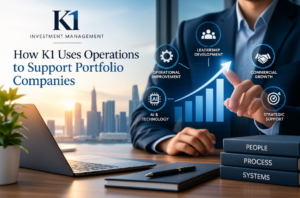
Investment capital may give a company resources, whereas growth has the potential to bring new operational issues. A company that increases its base of customers twice might require a larger sales organisation, more advanced financial reporting, more executives, better product management and better internal systems. K1 addresses these challenges through K1 Operations LLC and its operating framework. The firm’s operating strategy is structured around three areas: people, process, and systems. This approach aligns with the broader principle of operational value creation, which involves identifying performance gaps, strengthening management, improving business processes, and developing a practical plan for sustainable growth. K1 explains these as pragmatic elements of its functioning with portfolio companies.
People
As a technology company grows, strong leadership becomes increasingly important. The K1 operational model has executive recruiting and leadership development that assist the portfolio companies in creating teams that can handle a larger scale. This is shown in the 2025 results of K1. The company reported nearly 200 leadership hires across its portfolio during the year. The number does not imply that all appointments had a specific financial result. It, nevertheless, shows that executive development and recruitment are significant components of the operating model of K1.
Process
Expansion may reveal the flaws in sales, marketing, customer success, and other business operations. K1 mentions that its operating team collaborates with businesses in the areas of global business development, practical workshops, peer insights and market intelligence. The goal is to make growth more systematic rather than relying entirely on processes established by the founders. This can be particularly significant in the case of an enterprise software business, as customers can be spread across industries and countries, and their sales cycles might involve several decision-makers.
Systems
The other aspect of the running structure is technology. K1 claims to cooperate with portfolio companies to introduce technology stacks, enhance operational efficiency, incorporate AI-driven solutions, and develop real-time visibility of key business metrics. This practice is an indication of a wider shift in software investment. Artificial intelligence is becoming a part of products and internal processes, but to be successful, AI implementation needs more than a chatbot or an automated feature. To implement such capabilities in products that customers already rely on, companies need to find practical uses of the capabilities and integrate them.
How Artificial Intelligence Fits Into K1’s Investment Approach
K1 has been including AI as a more and more prominent investment strategy. The company currently identifies itself as one of the largest small-cap AI-enabled technology investors and concentrates on those firms that are developing AI-powered, mission-critical systems of record. This focus reflects a broader shift in private equity, where AI-driven value creation is becoming an important part of portfolio company transformation. One example of K1’s AI-focused investment strategy is Spin.AI. Announced in March 2026, the investment was in a company specializing in cloud security and data protection. K1 described Spin.AI as a platform designed to help organizations protect their cloud environments and business data.
Spin.AI’s platform helps organizations protect data and manage security risks across environments such as Google Workspace, Microsoft 365, Salesforce, and Slack. The investment is topical since security is one of the areas where enterprise customers have an evident operational need. AI can also support threat detection, security monitoring, and incident response. However, the software itself must be reliable and fit into existing enterprise settings. Another example of an earlier phase of the AI strategy of K1 is given by Board Intelligence.
The company offers board management software, and K1 claimed that the investment will help it expand its products, grow geographically, acquire, and invest more in AI. The 2025 review of K1 also provides information on AI applications in a number of portfolio firms. These are communications compliance, travel and expense management, enterprise learning and RFP response automation. This implies that the AI strategy of K1 does not just focus on investing in the businesses that offer standalone AI products only. The company is also keen on integrating AI into existing enterprise systems.
What K1’s 2025 Results Reveal About Its Activity
K1’s Year in Review provides useful information about the firm’s recent activity. The company has six realisations in the year, two of which are with public companies. It also recorded over 60 transactions and 29 new investments. The 2025 Inc. 5000 list of the fastest-growing companies in America listed 30 of its companies in its portfolio.
K1 also reported nearly 200 leadership hires across its portfolio and more than $2.3 billion in debt financing across 17 transactions. These figures give helpful data on activity, although they cannot be construed as a direct indication of investment returns. Other financial concepts are transaction volume, debt financing, portfolio-company growth and investor returns. It is particularly significant in the discussion of the topic of private equity. A company can grow to a large size without the growth necessarily leading to a given payoff to individual investors.
Investment performance depends on several factors, including entry valuation, financing structure, ownership, operating performance, exit valuation, fees, and timing. Disclosures in K1’s 2025 review state that disclosure of information about portfolio companies is not supposed to be disclosure of the outcome of an investment that an investor has achieved.
K1’s Portfolio Shows a Focus on Category-Building Software
Another understanding of the strategy of the firm is through the portfolio and realised investments of the firm. K1’s realized investments include Apttus, Axcient, Buildium, Certent, Checkmarx, Clarizen, Crownpeak, GoCanvas, Granicus, Irwin, Litera, Rave Mobile Safety, Subsplash, TechnoMile, Workforce Software, and approved. These companies are within various markets in enterprise technology, but they are united by a key feature: they all serve a specific business purpose, as opposed to a general-purpose consumer technology product.
The history of TechnoMile explains the use of K1 in describing its operating partnership. K1 states that it began working with TechnoMile and its founder in 2019, supporting product expansion, AI integration, team development, and improvements to its processes and customer-focused capabilities.According to K1, TechnoMile later expanded into a platform to serve over 250 government organisations. K1 announced the realization in 2025, and the transaction closed in January 2026.
Another example is Subsplash. In 2019, K1 invested in the company, and in 2025 it was acquired by Roper Technologies. K1 wrote that Subsplash had increased its annual recurring revenue about sevenfold compared to the previous fiscal year of its investment, and the company had expanded its platform to include AI-powered content, live streaming, church management, and additional features. These examples assist in understanding what K1 refers to when referring to building category leaders: the idea is to grow specialised software businesses into bigger platforms with more robust products, increased customer uptake, and increased capabilities.
Add-On Acquisitions Are Part of the Growth Model
One of the ways through which a software company can grow is through organic growth. The other one is by way of acquisitions of complementary businesses. The 2025 review of K1 reveals that add-on acquisitions have been a significant element of activity within its portfolio. Some of the examples were Singu and Micad in property management software, TeamDynamix and Sassafras in IT asset management, and XTM International with a number of complementary technology businesses. The case of the Singu and Micad merger is also instructive. K1 declared the deal as a strategic investment aimed at uniting two European software providers of real estate management. The combined businesses serve several areas, including facility management, maintenance automation, sustainability reporting, asset management, space planning, and compliance.
K1 claimed that the two platforms assisted over 100,000 buildings in 35 countries. An add-on acquisition may help a software firm enter new markets, add complementary functionality, expand geographically, or enhance the value of its existing platform. Integration needs are created by acquisitions as well. There is a need to integrate technology systems, workers, consumers, the pricing systems and the internal processes. The strategic justification of an acquisition thus does not ensure a good result. This operational implementation is particularly suitable in the case of the model of K1. The purchase is just the start; the merged company has yet to produce a consistent product and retain customer relationships.
Leadership Is a Major Part of the K1 Model
K1’s team materials emphasize an entrepreneurial culture and describe the firm’s operating approach through three areas: people, process, and systems. Neil Malik, partners and investment and operating professionals are all found on the current team page of the firm. K1 recognises Neil Malik as the Founder and CEO. In a 2025 podcast published by K1, Malik discussed the firm’s growth since launching its first $250 million fund in 2011 and how the organisation has maintained its focus on small-cap enterprise software and increased its asset base. Instead of leadership being a sideline to K1, it has integrated executive recruitment into portfolio support.
This is a fundamental fact of the development of a private company. The management needs of a business generating $20 million in revenue can differ significantly from those of a much larger company. The company also has K1 Accelerate events and other executive forums that are aimed at linking leaders in its network. As of 2025, K1 had over 40 Accelerate events, more than 6,400 strategic introductions and more than 1,300 attendees. These operations are in the larger context of K1 to establish a network around its portfolio and not to consider each investment as a discrete operation.
Recent Investments and Realisations Show How the Strategy Is Applied
The strategy of K1 can be easier to understand with the help of looking at individual transactions. In 2024, K1 took over MariaDB, after a tender offer to purchase 100 per cent of the issued ordinary shares of the company. The deal was termed a strategic investment which will help MariaDB expand its enterprise and further develop its database technology. In the same year, K1 invested in Board Intelligence, in which the founders were minority shareholders and still headed the business. K1 indicated that the investment would subsidise product development, geographic expansion, organic growth, and acquisitions.
In 2025, K1 announced the sale of Subsplash to Roper Technologies. K1 reported that this was its fifth exit to a strategic buyer and its third to a publicly listed acquirer in the preceding year. K1 had also finalised TechnoMile realisation, which will close the transaction in January 2026. The company was acquired through a strategic transaction involving SIMS Software. Collectively, these illustrations demonstrate that the activities of K1 span various phases of the private equity cycle: first investment, first-year growth, acquisitions and subsequent add-ons, and ultimate realisation.
What Entrepreneurs Can Learn From K1’s Approach
Even though the model of K1 is geared towards institutional private equity as opposed to regular personal investment entrepreneurship can still gain insights into the working principles of this model. One key lesson is the importance of supporting growth with stronger business infrastructure. The promotion of sales without finance, customer, leadership, product development, and internal systems can cause new issues rather than address the old ones.
Another lesson is the importance of treating technology as a business strategy. The operating structure of K1 focuses on AI and automation, but the examples of its portfolios indicate that technologies are used to implement particular business functions. It is more advantageous than using AI just because it is a modern trend in the market. Leadership is another important factor. The focus K1 has on executive recruitment and development is indicative of how companies have to transform their management models as they get increasingly complicated.
The lesson in the use of acquisitions by the firm is also there. Acquisition is a fast track to growth, but the actual task is to incorporate the acquisition product, people, technology and customers into a harmonious business. Lastly, the portfolio of K1 shows the need to have a clear position in the market. Companies that provide a particular, valuable business service are able to build strong relationships with the customers when their software becomes a valuable component of day-to-day operations.
Risks Behind a Technology-Focused Private Equity Strategy
K1’s investment strategy also involves risks that should not be overlooked. Enterprise software markets can evolve rapidly. AI can open up new possibilities, yet it can also render the existing products less differentiated. Their failure to evolve their technology can make them stronger competition with newer platforms. There are also risks associated with acquisitions. The merging of two or more software companies can be characterised by technical integration, cultural differences, customer retention and unforeseen expenses. The structural risks of private equity per se exist. Investments in private companies tend to be less liquid than publicly traded securities, and it can take years before the actual realisation of an investment. Investment outcomes can also depend heavily on the valuation at which a company is acquired and the valuation achieved when it is sold.
The fact that K1 has an emphasis on technology does not eliminate these risks. Rather, it puts significant emphasis on the capacity of the firm to find appropriate firms and assist the management teams in implementing their growth plans. Company-level growth and investor returns also should be differentiated. The examples of revenue growth, acquisitions and strategic exits published by K1 explain the progress at portfolio companies. They should not automatically be interpreted as returns earned by investors in K1’s funds. This distinction is reflected in published disclosures of K1 itself.
The Future of K1 Investment Management
The present strategy of K1 has AI-enabled enterprise software as the core of its investment thesis. That emphasis indicates a more general change that is occurring in business technology. Enterprise software is also shifting away from traditional workflow automation to systems that are capable of analysing information, making recommendations, executing repetitive tasks, and helping employees make complex decisions.
The 2025 review of K1 demonstrates this trend with some examples of compliance in communications, cost control, enterprise learning, and RFP automation. Meanwhile, the company keeps on investing in software companies that can address already set enterprise issues. Spin (2026): its investment. However, AI, in particular, is concerned with the security of the cloud and data, and not with AI as a separate product category. Such an integration of old enterprise workflows with newer AI functions will continue to be a significant theme in the strategy of K1.
A key challenge will be distinguishing businesses with sustainable technology advantages from those benefiting primarily from temporary enthusiasm around AI. The end-user customer, in essence, enterprise customers, require a product that will be reliable, compatible with current systems, secure sensitive data and have a quantifiable operational value. In the case of K1, further implementation will then rely not just on identifying companies related to AI, but helping businesses turn technology into more capable products and stronger enterprise relationships.
Final Thoughts
K1 Investment Management illustrates an operationally focused approach to private equity investing centered on enterprise software. The model used by the firm is a mix of investment capital and a systematic people, process and technology approach.
Through K1 Operations, the firm supports portfolio companies with leadership development, commercial expertise, technology adoption, and operational improvements. Its recent performance also demonstrates how AI, add-on buys, and strategic exits have contributed to the growth of enterprise software companies. MariaDB, Board Intelligence, and Spin are among the companies associated with K1’s investment history. TechnoMile and Subsplash further illustrate the variety of businesses represented in its technology-focused strategy. For entrepreneurs, the broader lesson is that sustainable growth requires more than capital.
The development of a company can be influenced by leadership, operational discipline, technology, customer relationships and well-considered acquisitions. K1 also proves useful to the reader examining the topic of private equity to understand why the activity of investments is to be considered. Portfolio growth and successful exits might offer helpful evidence on what a firm has done, but not alone determine the returns made to individual investors. Ultimately, K1 Investment Management is better understood as a case study of how private equity can combine capital with operational expertise to build technology businesses over the long term, rather than as a guaranteed path to wealth.
Disclosure: This article is informational and educational in nature and is neither financial nor investment advice nor legal advice. There are risks associated with investments in private equity such as illiquidity and loss of capital. Information about K1 and its portfolio companies is based on publicly available sources and company announcements and may change over time. Before they make an investment decision, readers are advised to do their own research and consult with qualified professionals.
Follow Invest Daily Times on Facebook, Instagram, and Twitter for insights on K1 Investment Management, private equity, AI-powered enterprise software, business growth, and investment trends.










Leave a comment